

Child Pushes and Hits Friends: Sensory Issues and Proprioception
Pushing and hitting may not be a bad habit to break, but a signal from a body that struggles to control its strength.

When a child keeps pushing friends or hitting too hard, it doesn't always come from personality or bad habits. Quite often it starts with difficulty regulating the body's senses. If your daycare or preschool has told you "your child pushes other kids" or "there's some hitting," and you've been wondering whether your child is aggressive, take a second look through the lens of sensory issues, as laid out by Ssukssuk Child Development Center in Bangbae, Seocho.
Where does pushing and hitting come from?
Before trying to fix the behavior right away, the first step is understanding why it happens. You might suspect a sensory cause if your child:
- Has trouble controlling how much force they use
- Plays rougher and rougher as play goes on
- Suddenly pushes or hits in the middle of playing with a friend
- Gets rougher the more excited they become
Discipline alone often doesn't solve behaviors like these.

Proprioception sets how strong a touch is
Our bodies have a sense that controls force and movement, called proprioception. When proprioception works well, a child automatically adjusts how tightly to hold something, how hard to push, and how to touch someone without hurting them.
When proprioception is dull or unstable, though, a child can't really feel how much force they're using. That's how something that starts as play turns into rough behavior.
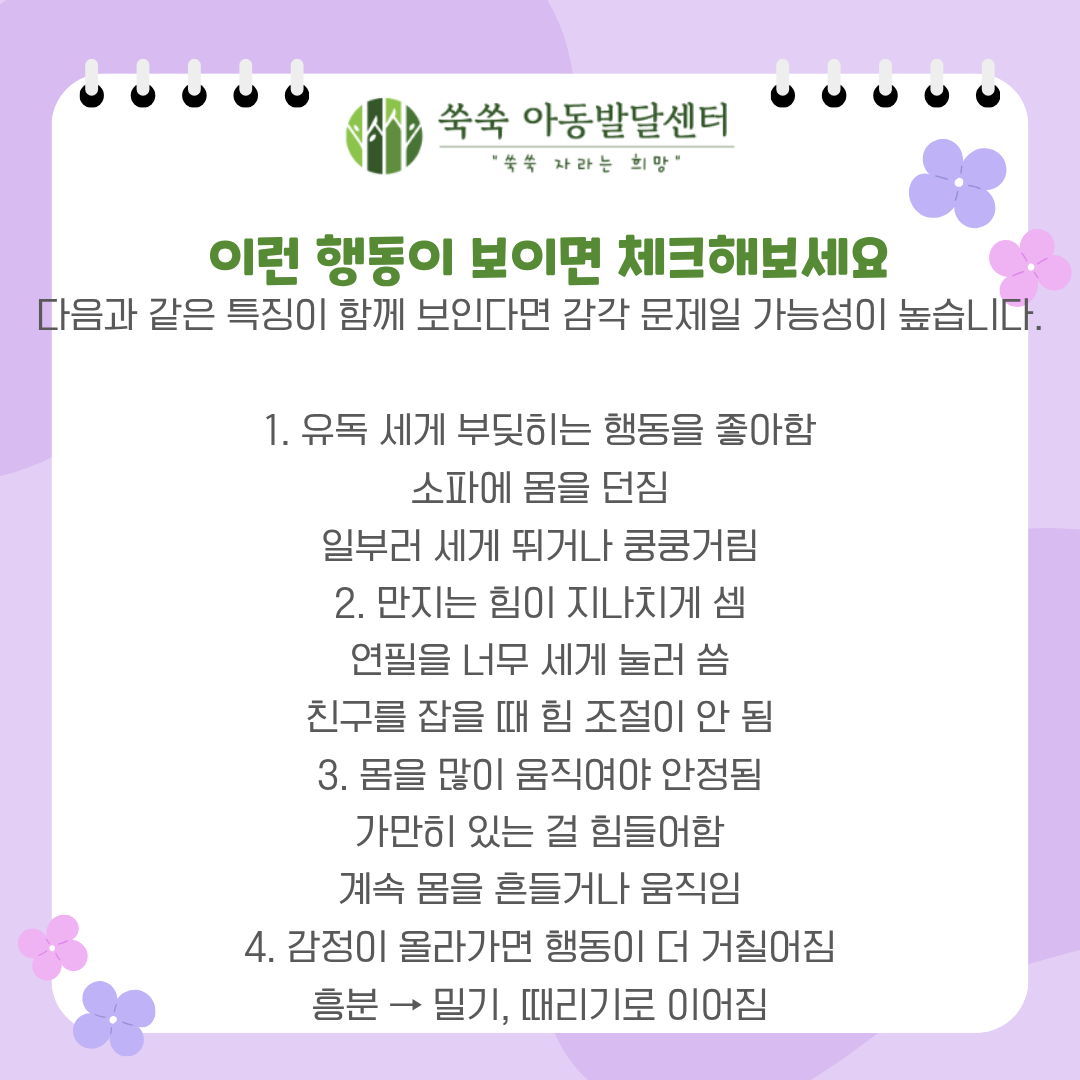
Four signs that point to a sensory issue
- Loves crashing into things — throws themselves onto the sofa or stomps hard on purpose.
- Touches with too much force — presses down too hard with a pencil and can't control their grip when grabbing a friend.
- Needs lots of movement to settle — finds it hard to stay still and keeps rocking or moving.
- Gets rougher when emotions run high — excitement quickly turns into pushing and hitting.
If you see several of these together, a sensory issue is likely.
Before you scold
Saying "No hitting!" or "Why are you so rough?" rarely gets to the root of the problem. From your child's point of view, it's hard to understand why they're in trouble for something they didn't even mean to do. When you see this behavior, first consider that it may come from difficulty with regulation rather than deliberate aggression.

When you focus on calming your child's senses, the behavior can ease on its own.
- Plenty of heavy-work activities : pushing a blanket, carrying heavy objects, rolling on a mat
- Show "not hard, like this" : be specific, such as "touch gently" or "this is how we use our hands"
- Regulate before excitement builds : take a short break or switch to a quiet activity before play gets too heated
- Consider a sensory integration approach : if the same behavior keeps happening, check your child's sensory profile with a professional assessment

In closing
Even when something looks like "problem behavior," there's a reason behind it from your child's side. What matters more than stopping the behavior is understanding why it happens. When you see pushing and hitting as a signal from your child's body and senses, the way you understand your child, and the way you help, both change.

At Ssukssuk Child Development Center, we start by listening closely to your child and to you, getting a clear picture of where your child is right now, and then recommend the right treatment direction based on our center's diagnostic criteria.
Last reviewed: 2026-10-07 This article provides general information. Your child's developmental status and treatment plan are determined through consultation and assessment.