
Rehab and Manual Therapy After Rotator Cuff Surgery
Rotator cuff surgery only repairs the tissue; rehabilitation that restores the stiff joint and weakened muscles is what changes the outcome.
"I had surgery, so shouldn't I be all better now?" That's what many people expect after rotator cuff surgery. But even as time passes, some people find their arm still won't rise well, or they're left with stiffness, night pain, or weakness. Here's why rehabilitation after rotator cuff surgery changes the outcome, and what manual therapy does along the way.
What is the rotator cuff?
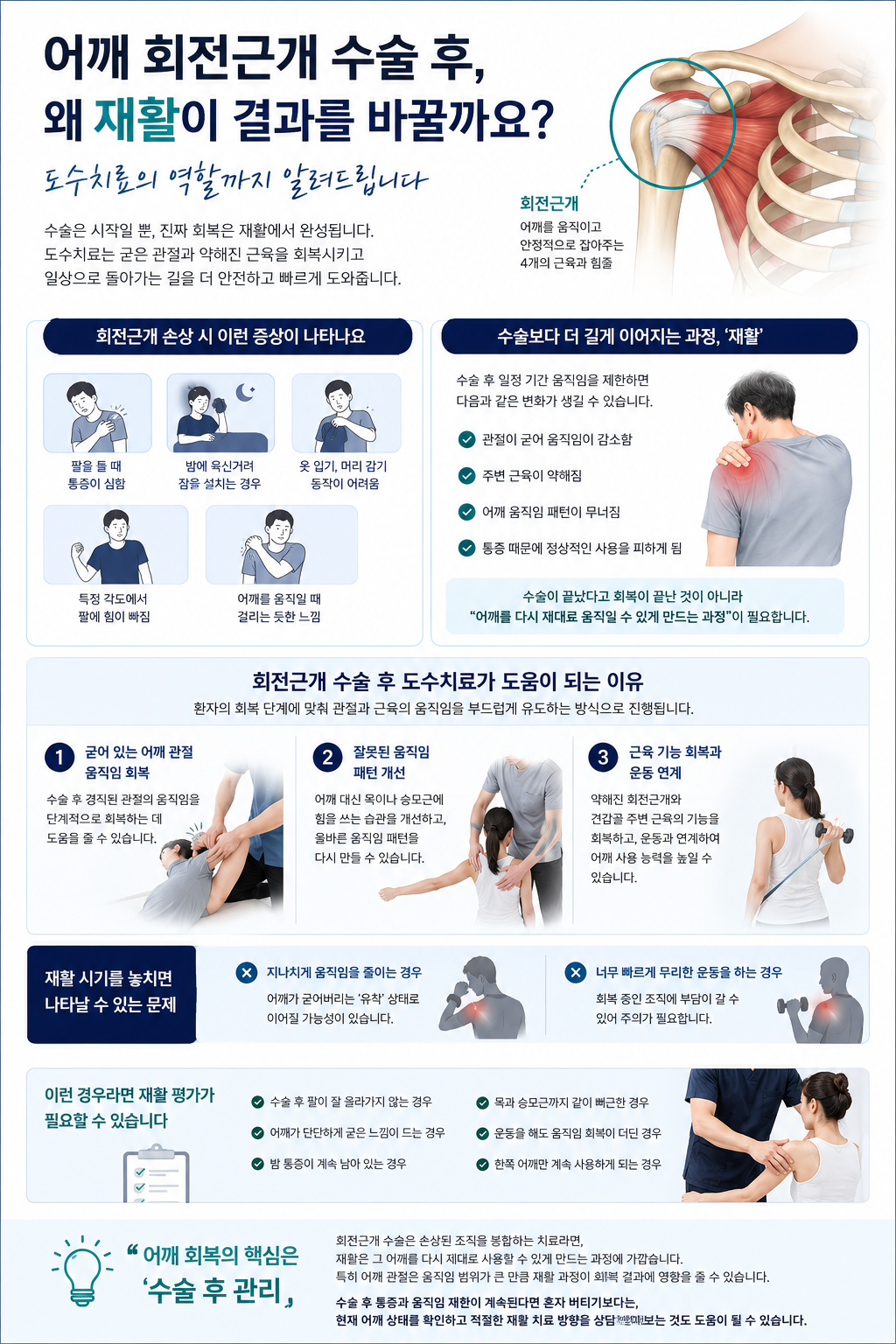
The rotator cuff is a group of four muscles and their tendons that move the shoulder and hold it securely in place. Because it's deeply involved in raising and rotating the arm, an injury makes everyday life difficult across the board.
- Raising your arm is very painful
- Throbbing pain at night disrupts your sleep
- Getting dressed or washing your hair is difficult
- Your arm loses strength at certain angles
- You feel a catching sensation when moving your shoulder
When the injury is extensive or the tear is severe, surgical treatment is considered.
Rehab lasts longer than surgery
After rotator cuff surgery, the repaired tissue needs time to heal firmly, so movement is restricted with a brace for a while. The challenge comes after that. A shoulder that hasn't been used for a long time goes through changes like these:
- The joint stiffens and movement decreases
- The surrounding muscles weaken
- Shoulder movement patterns break down
- You avoid normal use because of pain
The end of surgery isn't the end of recovery—there's still the process of getting the shoulder to move properly again.
Three ways manual therapy helps
The core of post-surgical rehab is gradually releasing stiff tissue and movement restrictions. Manual therapy gently guides joint and muscle movement in step with each stage of recovery.
Restoring movement in a stiff shoulder joint — A shoulder that's had surgery stiffens easily, and lifting the arm or reaching behind the back is especially limited. Manual therapy helps regain joint movement step by step.
Correcting faulty movement patterns — When pain lasts a long time, people develop the habit of tensing the neck or trapezius instead of using the shoulder, which spreads into neck pain, upper back tightness, and postural imbalance. Rehabilitation re-establishes proper movement patterns.
Restoring muscle function and linking to exercise — The rotator cuff and the stabilizing muscles around the shoulder blade weaken quickly after surgery. Combining manual therapy with exercise therapy helps restore shoulder movement and muscle use together.
What can happen if you miss the window for rehab
If fear of pain makes you limit movement too much, it can lead to adhesions that leave the shoulder frozen. On the other hand, rushing into strenuous exercise too soon puts stress on tissue that's still healing. After surgery, you need a rehabilitation plan matched to your current stage of recovery.
Signs you should get a rehabilitation evaluation
- Your arm still doesn't rise well after surgery
- Your shoulder feels firmly stiff
- Night pain persists
- Your neck and trapezius feel tight too
- Movement is slow to recover even with exercise
- You find yourself using only one shoulder
In closing
- If rotator cuff surgery is the treatment that repairs damaged tissue, rehabilitation is the process that lets you use that shoulder again.
- The shoulder has a wide range of motion, so the rehabilitation process affects the outcome of recovery.
- If pain and limited movement continue after surgery, don't tough it out alone—talk with us about your shoulder's current condition and the right direction for rehab.
Last reviewed: 2026-10-07
This article provides general medical information. Individual diagnosis and treatment plans are determined through an in-person consultation.