
Frozen Shoulder: When You Can't Raise Your Arm—Causes and Treatment
Rather than waiting for frozen shoulder to resolve on its own, manage it in step with its stage: pain control, then range of motion, then strength.
People often say frozen shoulder goes away with time, but in reality the pain and limited movement often drag on and make daily life difficult. If washing your hair, getting dressed, or reaching behind your back is especially uncomfortable, it's worth suspecting a shoulder joint problem before assuming it's muscle pain. For anyone struggling with shoulder pain that keeps the arm from rising, here are the causes, symptoms, and treatment of frozen shoulder.
Frozen shoulder's proper name: adhesive capsulitis
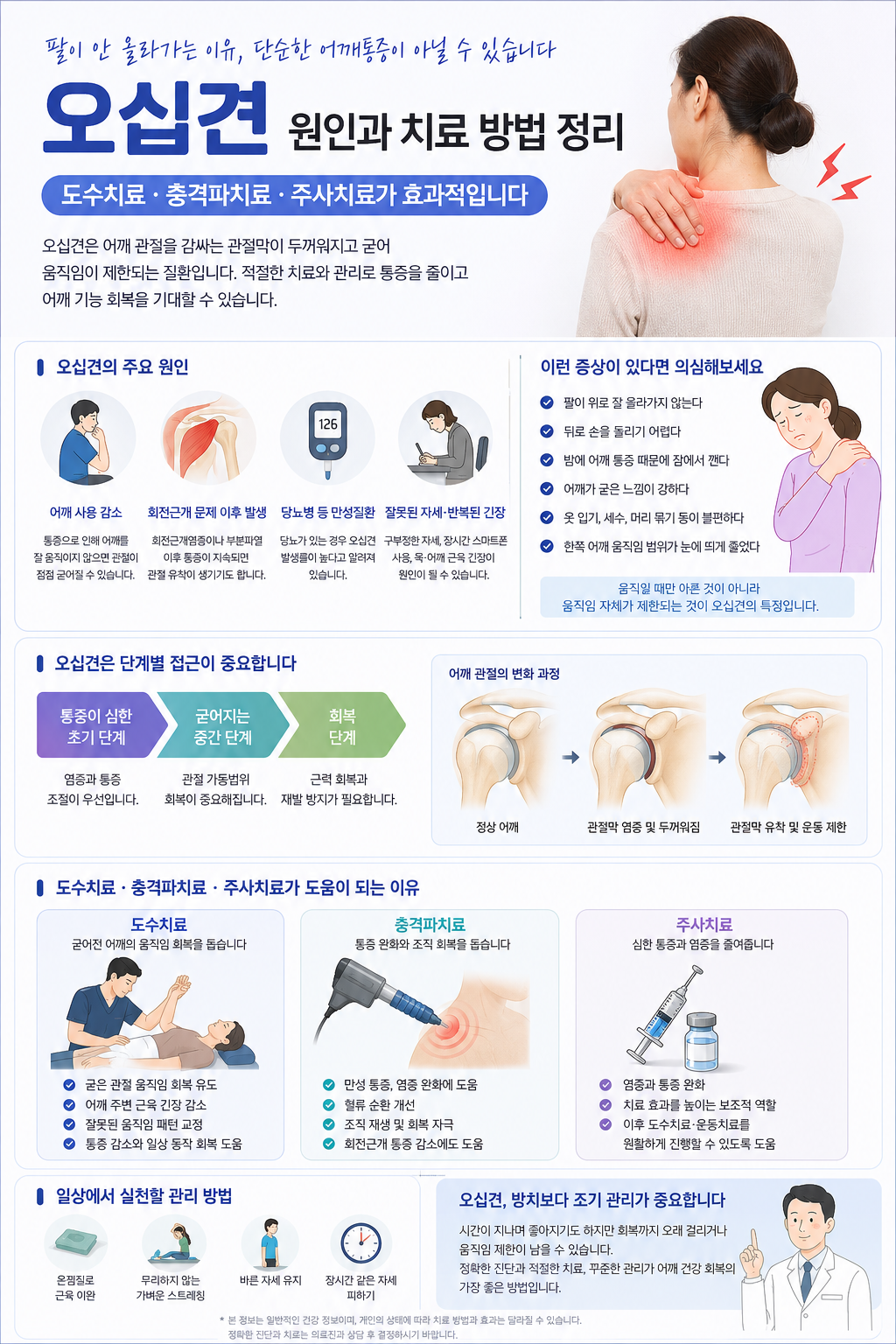
The medical name for frozen shoulder is adhesive capsulitis. It's a condition in which the capsule surrounding the shoulder joint thickens and stiffens, restricting movement. In Korea it's commonly called the "50s shoulder," which makes people think of it as a condition of one's 50s, but it's common between the ages of 40 and 60, and these days it can develop earlier due to long hours at the computer or lack of exercise.
What makes the shoulder stiffen?
Three main causes are known to lead to frozen shoulder.
- Reduced shoulder use: When pain makes you use the shoulder less, the joint gradually stiffens. Early shoulder pain that's left alone often progresses to frozen shoulder.
- After a rotator cuff problem: If pain continues after rotator cuff inflammation or a partial tear, movement decreases and joint adhesions can form.
- Poor posture and repeated tension: A hunched posture, long periods of smartphone use, and tension in the muscles around the neck and shoulders can also lock up shoulder movement.
Suspect frozen shoulder if you have these symptoms
- Your arm gets stuck partway as you raise it
- It's hard to reach behind your back
- Shoulder pain wakes you up at night
- Your shoulder feels very stiff
- Getting dressed, washing your face, or tying your hair is difficult
- One shoulder's range of motion has noticeably decreased
What sets frozen shoulder apart is that it doesn't just hurt to move—movement itself becomes blocked.
Treatment goals differ at each stage
In rehabilitation medicine, we first determine which stage you're in and then plan treatment. Pushing exercise without regard to the stage can actually make shoulder pain worse.
The roles of manual therapy, shockwave therapy, and injections
Manual therapy — The goal is to restore movement in the stiff tissues and joint of the shoulder. It evaluates movement not only of the shoulder but also of the neck, upper back, and shoulder blades, releasing tight muscles and improving restricted movement. It helps restore movement in the stiff joint, reduce muscle tension, correct faulty movement patterns, and regain everyday movements. If you compensate heavily when lifting your arm, structured rehabilitation becomes even more important.
Shockwave therapy — Delivers a physical stimulus to the tissues around the painful area to support recovery. It's used to relieve chronic pain, knots, and inflammation in the shoulder tendons and muscles, and it can also help reduce the rotator cuff pain that often accompanies frozen shoulder. Intensity and number of sessions are determined by your pain level and degree of movement restriction.
Injection therapy — Used alongside other treatments when pain makes it hard to sleep or even to move. Reducing inflammation and pain first makes subsequent manual therapy and exercise therapy easier. Whether it's appropriate is decided after evaluating your current condition and pain stage.
Things to remember
- Frozen shoulder is a condition in which the joint capsule thickens and stiffens so the arm won't rise; waiting for it to resolve on its own can leave lasting movement limits.
- The more you limit movement because of pain, the stiffer the joint becomes, so early management is important.
- If your shoulder stays stiff and arm movement remains uncomfortable, visit a rehabilitation medicine clinic to identify the cause and stage and set up the right treatment plan.
Last reviewed: 2026-10-07
This article provides general medical information. Individual diagnosis and treatment plans are determined through an in-person consultation.