

Lumbar Spinal Stenosis: Leg Numbness When Walking & Nonsurgical Care
Leg numbness that forces you to stop and rest while walking may be a sign of lumbar spinal stenosis, and you can begin managing it with nonsurgical treatment before considering surgery.
When it comes to low back pain, many people think of a herniated disc first, but for middle-aged and older adults, lumbar stenosis is just as common a cause. If your legs keep going numb and feeling tight when you walk, it's worth checking for spinal stenosis before blaming fatigue. Here we walk through how lumbar stenosis develops, its symptoms, and the role nonsurgical treatment plays.

A Condition in Which the Nerve Passage Narrows
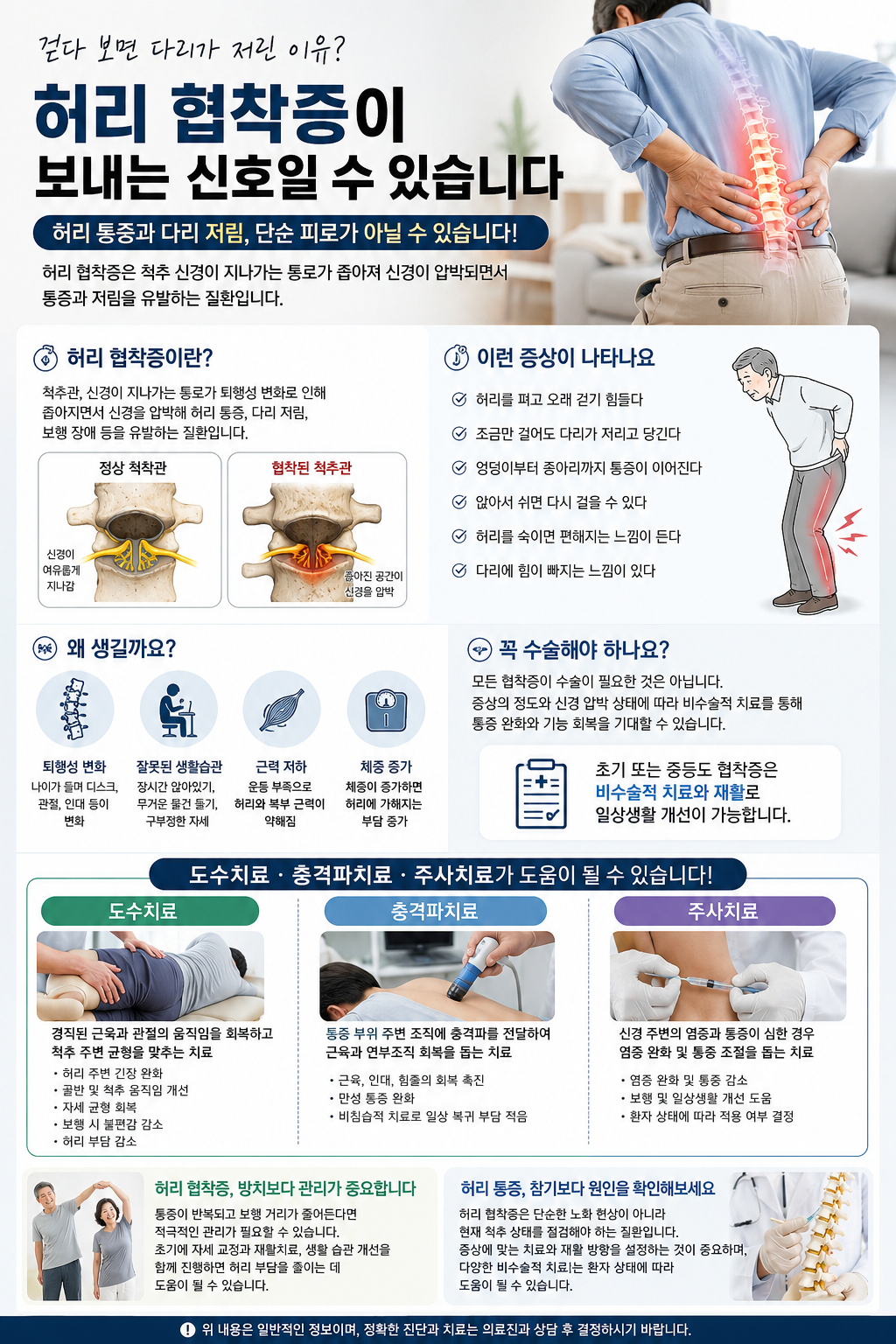
Inside the spine is a passage through which nerves travel down. Lumbar stenosis is a condition in which this passage narrows for various reasons and the nerves are compressed. With age, the ligaments around the spine can thicken and the joints can undergo degenerative changes, gradually reducing the width of the passage.
As the passage narrows, the nerves are compressed, causing low back pain and leg numbness together. It is common after age 50, and a hallmark of lumbar stenosis is that symptoms get worse with prolonged standing or walking.
If Your Legs Go Numb When You Walk, Look for These Signs
Lumbar stenosis is not just a condition that makes your back hurt. Signs that commonly appear together include:
- It's hard to walk for long with your back straight
- Your legs go numb and feel tight after walking only a short distance
- Pain travels from the buttocks down to the calves
- After sitting and resting briefly, you can walk again
- Bending forward actually feels more comfortable
- Your legs feel weak
At first it's easy to brush off, but if left alone, walking itself can become difficult, so early care is important.
Lifestyle Habits Add to Degenerative Changes
The biggest cause is degenerative change. Over time, the spinal joints and discs wear down and the surrounding tissues thicken, pressing on the nerves. When poor posture and a lifestyle that repeatedly strains the lower back are added on top, the effects grow.
Habits that increase strain on the lower back include a mostly sedentary lifestyle, frequent heavy lifting, lack of exercise, weak abdominal and back muscles, and a slouched posture.
Is Surgery the Only Answer for Lumbar Stenosis?
Many people worry about surgery as soon as they are diagnosed with stenosis. However, not every case of stenosis leads to surgery. Depending on the severity of symptoms and the degree of nerve compression, nonsurgical treatment can be tried first to relieve pain and restore function, and in early or moderate cases, rehabilitation-centered treatment is often combined with the goal of improving daily life.
Manual therapy is used to release a state in which pain has broken down your posture and only certain muscles are overly tense, and when combined with exercise therapy it helps stabilize the lower back. Shockwave therapy is performed without incisions, so returning to daily life afterward is relatively easy. Whether injection therapy is appropriate varies by individual, so it is planned after your condition is checked during a visit.
In Summary
- If your legs go numb and you have to stop often while walking, lumbar stenosis may be the cause.
- Not every case of stenosis requires surgery; nonsurgical treatments such as manual therapy, shockwave therapy, and injection therapy are chosen to suit your condition.
- The earlier you start posture correction, rehabilitation, and lifestyle changes, the easier it is to relieve strain on your lower back.
At Ssukssuk Rehabilitation Medicine Clinic near Bangbae Station, we first check your posture and left-right balance with an Exbody posture assessment, then decide on the direction of treatment.
Last reviewed: 2026-10-07 This article provides general medical information. Individual diagnosis and treatment plans are determined through an in-person consultation.