
Golfer's Elbow: Inner Elbow Pain When Lifting Things (Seocho/Bangbae)
You can get golfer's elbow without playing golf if you use your wrist repeatedly, and not missing the window for care shortens recovery.
"I don't even play golf, so why do I have golfer's elbow?" Because of the name, it's easy to assume only golfers get it, but it is actually common among homemakers, office workers, small business owners, and everyday people who enjoy exercise. That's especially true if your work involves frequent wrist use or lifting. So that you don't dismiss ongoing inner elbow pain as simple muscle soreness, here's why golfer's elbow develops and how to manage it.
Golfer's Elbow Is Damage That Builds Up in the Tendon
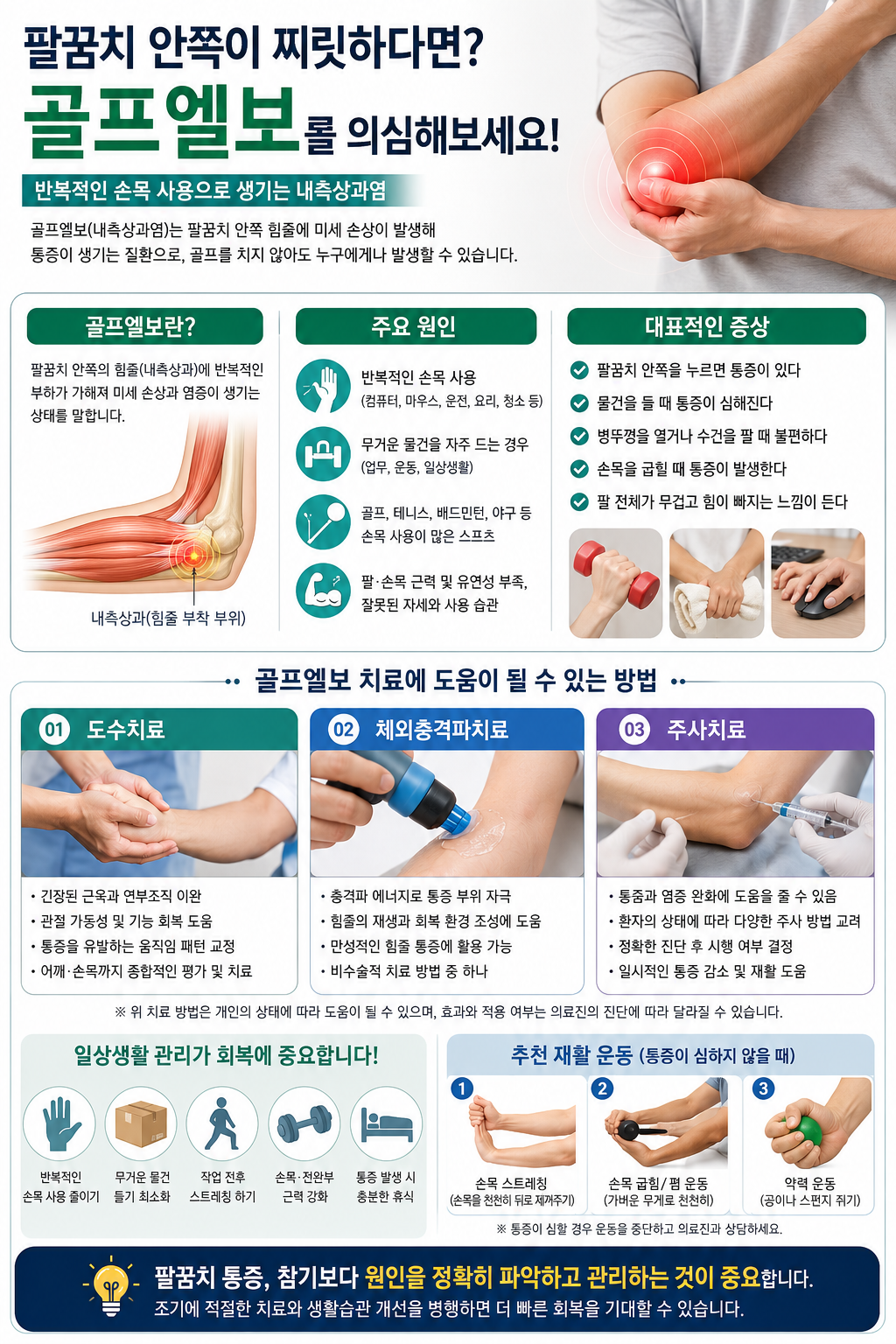
The medical name for golfer's elbow is medial epicondylitis. The muscles that move the wrist and fingers attach by tendons to the inside of the elbow, and repeating the same motion causes tiny injuries in these tendons, followed by inflammation and degenerative changes. This condition is commonly called golfer's elbow.
Everyday Wrist Movements Can Be the Cause
- Repetitive wrist use: Tasks where the same motion adds up, such as computer work, using a mouse, driving, cooking, and cleaning
- Lifting heavy objects: Work that keeps loading the arm and wrist, such as package delivery, manufacturing, and weight training
- Sports: Activities that use the wrist heavily, such as golf, badminton, tennis, and baseball
- Lack of strength or flexibility: When the balance of muscles around the arm and wrist breaks down, strain concentrates in one area
Common Symptoms of Golfer's Elbow
The inside of the elbow hurts when pressed, and the pain increases when you lift things. Opening a jar lid, wringing out a towel, or bending your wrist can also be uncomfortable, and your whole arm may feel heavy and weak. Even if it starts as mild discomfort, over time it can become severe enough to interfere with daily life.
Why Toughing It Out Leads to Chronic Pain
While you put up with it as muscle soreness, tendon healing slows and the pain can settle into a chronic problem. Using the arm less because of pain weakens the muscles, and compensation, where the shoulder or wrist takes over the work, can make other areas hurt as well.
Treatment and Daily Care for Golfer's Elbow
People with golfer's elbow often have problems not only in the elbow but also in the wrist, forearm muscles, and shoulder movement.
- Manual therapy: Improves the mobility of tense muscles and soft tissues to help restore joint function, and evaluates and corrects the movement patterns that trigger pain.
- Extracorporeal shockwave therapy (ESWT): A nonsurgical treatment that delivers shockwave energy to the painful area, used to create an environment that supports tissue healing in chronic tendon pain.
- Injection therapy: Decided by the medical team based on your condition and the extent of damage when pain is severe or inflammation persists.
In daily life, cutting back on repetitive wrist use and heavy lifting, stretching before work, doing wrist and forearm strengthening exercises, and resting enough when it hurts all reduce strain on the elbow.
In Summary
Golfer's elbow is common, but if you miss the window for care, recovery takes longer. If inner elbow pain keeps coming back whenever you lift things or use your wrist, get a diagnosis, and it's best to combine manual therapy, ESWT, injection therapy, rehabilitation exercise, and daily care to suit your condition. At Ssukssuk Rehabilitation Medicine Clinic, close to Seocho and Bangbae, we evaluate not only the elbow but also wrist and shoulder movement.
Last reviewed: 2026-10-07 This article provides general medical information. Individual diagnosis and treatment plans are determined through an in-person consultation.