
Spondylolisthesis: Spinal Slippage, Symptoms & Treatment (Bangbae/Seocho)
Pain that worsens when you bend backward, along with leg numbness, may be spondylolisthesis; after ruling out a herniated disc, nonsurgical treatment can be considered first.
Many people whose lower back hurts after standing or walking for a long time, with numbness spreading to the buttocks and legs, brush it off as muscle pain. But the cause may be spondylolisthesis, in which a vertebra in the lower back has slipped forward out of place. Here we compare spondylolisthesis with a herniated disc and explain its causes, symptoms, and how manual therapy, shockwave therapy, and injection therapy can help.
What It Means When a Vertebra Slips Forward
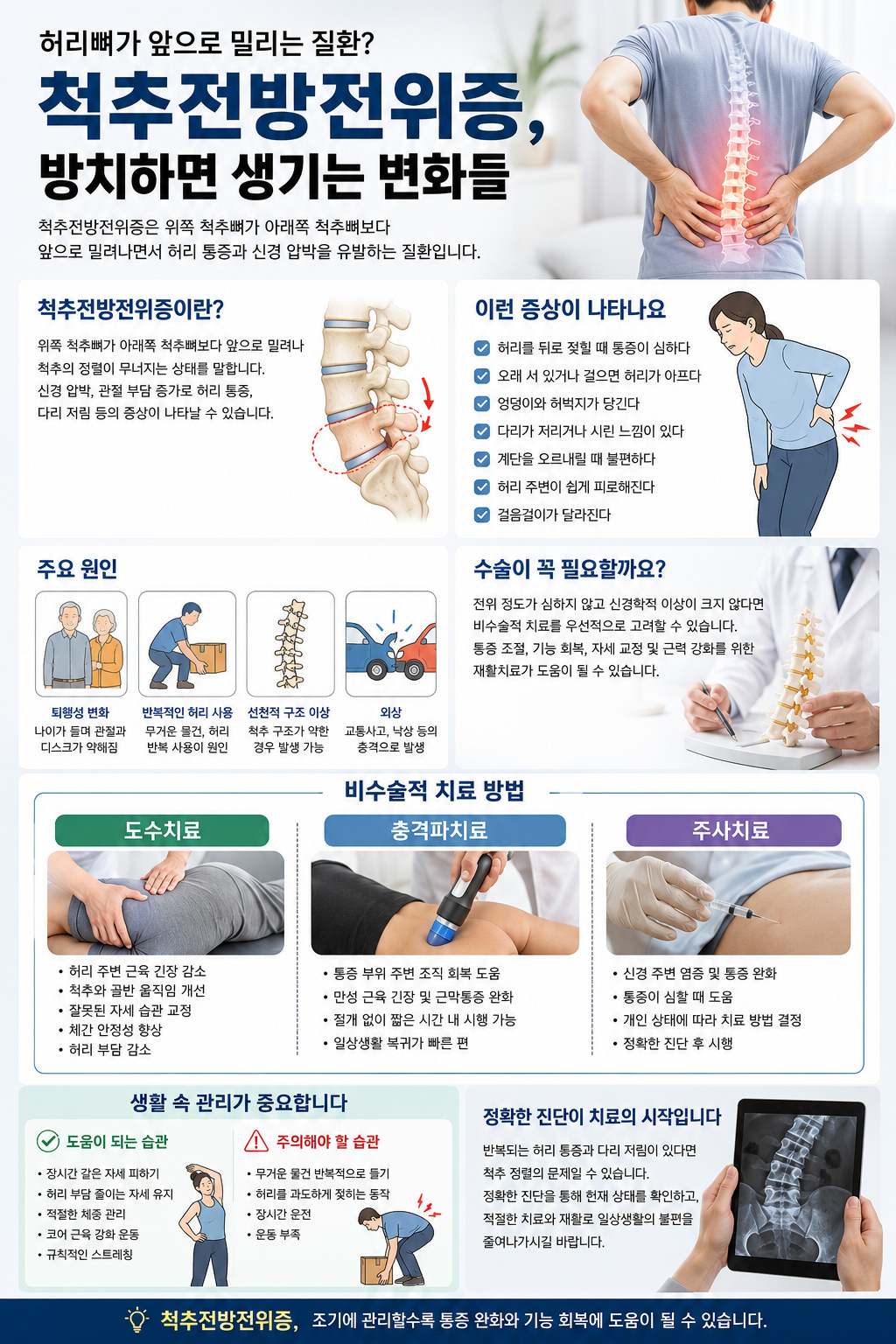
The spine is made of many bones stacked on top of one another to support the body. Spondylolisthesis is a condition in which an upper lumbar vertebra slides forward relative to the one below it, disrupting alignment. When a vertebra moves out of place, the surrounding joints, ligaments, and muscles are put under more strain, and nerves can be compressed. That is why it causes not only low back pain but also leg numbness and difficulty walking. It most commonly affects the lower lumbar levels, L4-L5 and L5-S1.
Spondylolisthesis vs. Herniated Disc: What's the Difference?
Both conditions cause low back pain and leg numbness, but they start from different places.
Because the causes and treatment approaches differ, it is important to distinguish them with imaging and a specialist evaluation.
Why It Happens and What Symptoms Appear
There are four main causes: the most common, degenerative changes that weaken the spinal joints and discs and reduce stability; a lifestyle of frequently lifting heavy objects or repeatedly arching the back; a congenitally weak spinal structure, which can cause it at a relatively young age; and strong impacts such as car accidents or falls.
Even if it begins as simple low back pain, the following symptoms may appear as it progresses.
- Pain gets worse when you bend backward
- Your lower back hurts when standing or walking for a long time
- Your buttocks and thighs feel tight
- Your legs feel numb or cold
- Going up and down stairs is uncomfortable
- Your lower back tires easily and your gait changes
In severe cases, nerve compression can weaken the legs.
Treatments to Try Before Surgery
Not every case of spondylolisthesis requires surgery. If the slippage is not severe and there are no significant neurological problems, nonsurgical treatment is considered first. Rehabilitation focused on pain control, functional recovery, posture correction, and strengthening is central.
- Manual therapy: A therapist evaluates and treats the joints and soft tissues, reducing tension in the muscles around the lower back and improving spinal and pelvic movement and trunk stability. Combined with exercise therapy, it helps strengthen the muscles that support the spine.
- Shockwave therapy: Helps tissue recovery when there is also excessive tension or myofascial pain around the buttocks, thighs, and pelvis. It involves no incision and is relatively quick.
- Injection therapy: Considered after examination and evaluation when inflammation around the nerves is severe or pain significantly interferes with daily life.
In daily life, avoid staying in one position for too long, manage your weight, and keep up core strengthening and regular stretching. Habits to avoid include repeatedly lifting heavy objects, excessively arching the back, long hours of driving, and lack of exercise.
In Summary
Spondylolisthesis is easy to dismiss as a normal part of aging, but if pain keeps coming back or comes with leg numbness, your spinal alignment should be checked. At Ssukssuk Rehabilitation Medicine Clinic near Bangbae and Seocho, we combine manual therapy, shockwave therapy, injection therapy, and rehabilitation exercise based on your diagnosis.
Last reviewed: 2026-10-07 This article provides general medical information. Individual diagnosis and treatment plans are determined through an in-person consultation.