
IT Band Syndrome: Causes and Treatment of Outer Knee Pain
A sharp pain on the outside of your knee after running or stairs may be IT band syndrome, and preventing recurrence means correcting pelvis and hip movement—not just the knee.
If the outside of your knee gives you a sharp pain after running or hiking, and that pain gets even more noticeable going down stairs, IT band syndrome is worth considering. It's known to be common among marathoners and runners, but we also see it often in people who've just started exercising and in office workers who walk a lot. To help you pinpoint the cause of recurring knee pain, here we explain how IT band syndrome develops and how it's treated.
Pain From Friction Between the IT Band and the Thigh Bone
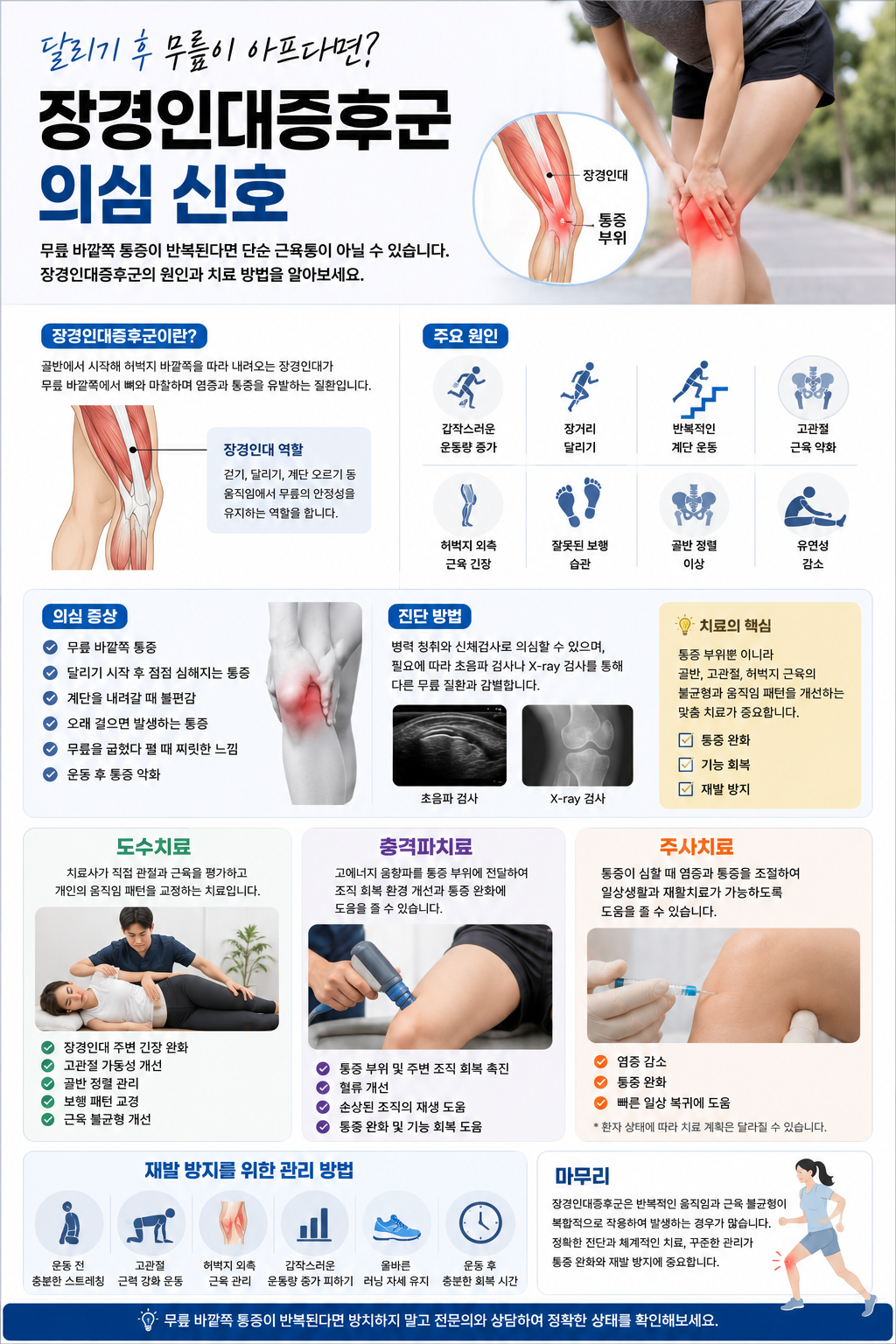
The iliotibial (IT) band is a thick band of fibrous tissue that starts on the outside of the pelvis, runs down the outer thigh, and attaches to the outside of the knee. It helps keep the knee stable during movements that use your legs, such as walking, running, and climbing stairs.
When overuse or excessive exercise causes the IT band to rub repeatedly against the femur (thigh bone), inflammation and pain develop—this is IT band syndrome. It's especially common in people who enjoy long-distance running, hiking, or cycling.
Why It's Not Just a Knee Problem
IT band syndrome often involves imbalances in the pelvis, hip, and thigh muscles. Typical causes include suddenly increasing your training volume, repeated long-distance running or stair workouts, weak hip muscles or tight outer thigh muscles, poor walking habits, pelvic misalignment, and reduced flexibility. That's why, rather than treating only the painful spot, we also need to evaluate the movement patterns behind it.
How Outer Knee Pain Shows Up
The outside of your knee hurts, the pain builds the longer you run, and going down stairs or walking for a long time is uncomfortable. You may feel a sharp twinge when bending and straightening your knee, and it may get worse after exercise. At first it may hurt only during exercise, but if left alone it can start to bother you in daily life, too.
IT band syndrome is suspected based on your medical history and a physical exam, and if needed, ultrasound or X-ray is used to rule out other knee conditions. Because symptoms can overlap with a meniscus tear or osteoarthritis, telling them apart is important.
Treatment for IT Band Syndrome
- Manual therapy: We evaluate abnormal movement in the pelvis and hip along with the knee, release tension around the IT band, and improve hip mobility, pelvic alignment, gait pattern, and muscle imbalances. Education on exercises to prevent recurrence is included.
- Shockwave therapy: A non-surgical treatment that uses high-energy acoustic waves to improve the healing environment of tissue sensitized by repetitive stress and to help manage pain.
- Injection therapy: Considered to control inflammation and pain when pain makes daily life or returning to sports difficult, and it must always be paired with rehabilitation to restore muscle and joint function.
Exercise Habits That Prevent Recurrence
With IT band syndrome, care after treatment determines the outcome. Stretch thoroughly before exercise, build hip strength, and take care of your outer thigh muscles. Increase your training volume gradually, maintain good running form, and allow time to recover after workouts. Ramping up intensity too quickly just because the pain is gone makes it easy for the problem to return.
One More Look
If outer knee pain keeps coming back, don't dismiss it as a sore muscle—find out the cause. IT band syndrome often results from a combination of repetitive movement and muscle imbalance, so it calls for both an accurate diagnosis and systematic care. At Ssukssuk Rehabilitation Medicine Clinic near Seocho and Bangbae, we evaluate hip and pelvic movement too, to help you get back to your sport.
Last reviewed: 2026-10-07 This article provides general medical information. Individual diagnosis and treatment plans are determined through an in-person consultation.