
Shoulder Instability: When Your Shoulder Feels Like It'll Pop Out
A shoulder that feels loose or like it might slip out may signal shoulder instability, and rehabilitation focused on restoring stability—not just pain relief—is key.
The shoulder has the widest range of motion of any joint in the body. It lets you raise your arm, rotate it behind you, and throw a ball—but the trade-off is that it's built with relatively little stability. That's why the shoulder easily becomes unstable and, in severe cases, can repeatedly dislocate or partially dislocate (subluxate). If your shoulder has popped out during sports, or it feels loose when you move your arm in a certain direction, it's worth understanding what shoulder instability is and how it's managed.
When the Structures That Hold the Shoulder Weaken
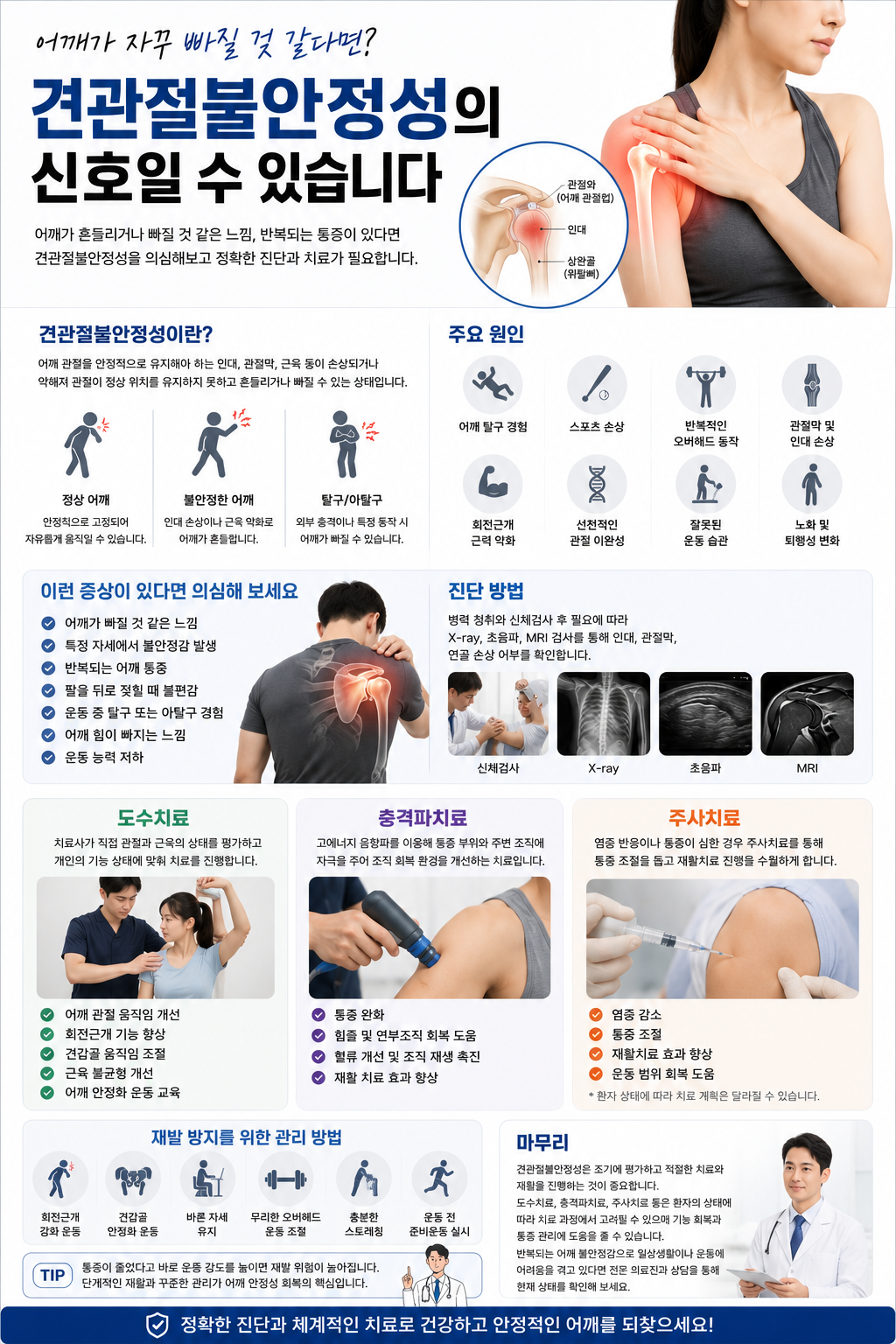
Shoulder instability is a condition in which the structures that should hold the shoulder joint in place are damaged or weakened, so the joint can't stay in its normal position. The shoulder is where the upper arm bone (humerus) meets the shoulder blade (scapula), and the surrounding ligaments, joint capsule, and rotator cuff muscles provide stability. When these structures are injured by trauma or repetitive use, the shoulder can easily shift or dislocate.
What Causes Shoulder Instability
Common causes include a previous shoulder dislocation, sports injuries, repeated overhead movements that raise the arm above the head, damage to the joint capsule and ligaments, rotator cuff weakness, naturally loose joints, and poor exercise habits. It's relatively common in athletes who frequently use their arms overhead, such as in baseball, volleyball, swimming, and tennis.
Get Checked If You Notice These Sensations
- A worried feeling that your shoulder might pop out
- Looseness that occurs only in certain positions
- Recurring shoulder pain
- Discomfort when you pull your arm back
- A dislocation or partial dislocation during sports
- A sense that your shoulder has lost strength and your athletic performance has dropped
It may feel like mere pain at first, but left untreated it can lead to recurrent dislocations.
Diagnosis involves your medical history and a physical exam, and if needed, X-ray, ultrasound, or MRI to check for damage to the ligaments, joint capsule, and cartilage. If you've had repeated dislocations, it's important to determine exactly how much the surrounding structures have been damaged.
The Goal of Treatment: Restoring Stability
People with shoulder instability often also have reduced function in the muscles around the joint and abnormal movement patterns.
- Manual therapy: We evaluate the joint and soft tissues to improve shoulder movement, correct rotator cuff function, scapular movement, and muscle imbalances, and teach stabilization exercises. It's often done together with exercise therapy.
- Shockwave therapy: Used not for the instability itself but to reduce accompanying tendon pain or soft-tissue discomfort and to support an environment for tissue recovery.
- Injection therapy: When inflammation or pain is severe, it controls the pain so you can continue rehabilitation. If there's significant structural instability, the treatment plan is based on the diagnosis.
Everyday Care to Prevent Recurrence
Reducing pain alone isn't enough—you need to restore your shoulder's stability. Rotator cuff strengthening and scapular stabilization exercises, good posture, moderating strenuous overhead exercise, and adequate stretching and warm-ups all help. If you've had recurrent dislocations, plan your return to sports even more carefully.
Key Takeaways
If your shoulder keeps feeling like it'll pop out, or the pain keeps coming back, don't dismiss it as a sore muscle. The earlier shoulder instability is evaluated and treatment and rehabilitation begin, the better. At Ssukssuk Rehabilitation Medicine Clinic in Seocho and Bangbae, we help restore shoulder stability with manual therapy and one-on-one exercise rehabilitation.
Last reviewed: 2026-10-07 This article provides general medical information. Individual diagnosis and treatment plans are determined through an in-person consultation.