
Herniated Disc in Seocho & Bangbae: Back Pain That Spreads to the Legs
Low back pain with leg numbness calls for checking for a herniated disc, and continuing everyday care after treatment helps prevent recurrence.
If your low back pain now comes with numbness in your buttocks, thighs, or calves, the first step is to check for a herniated disc rather than assume it's muscle pain. For people in Seocho and Bangbae considering treatment for back pain, we've outlined what a herniated disc is, the signs it shows, and how treatment and ongoing care work.
A Herniated Disc Is When a Disc Presses on a Nerve
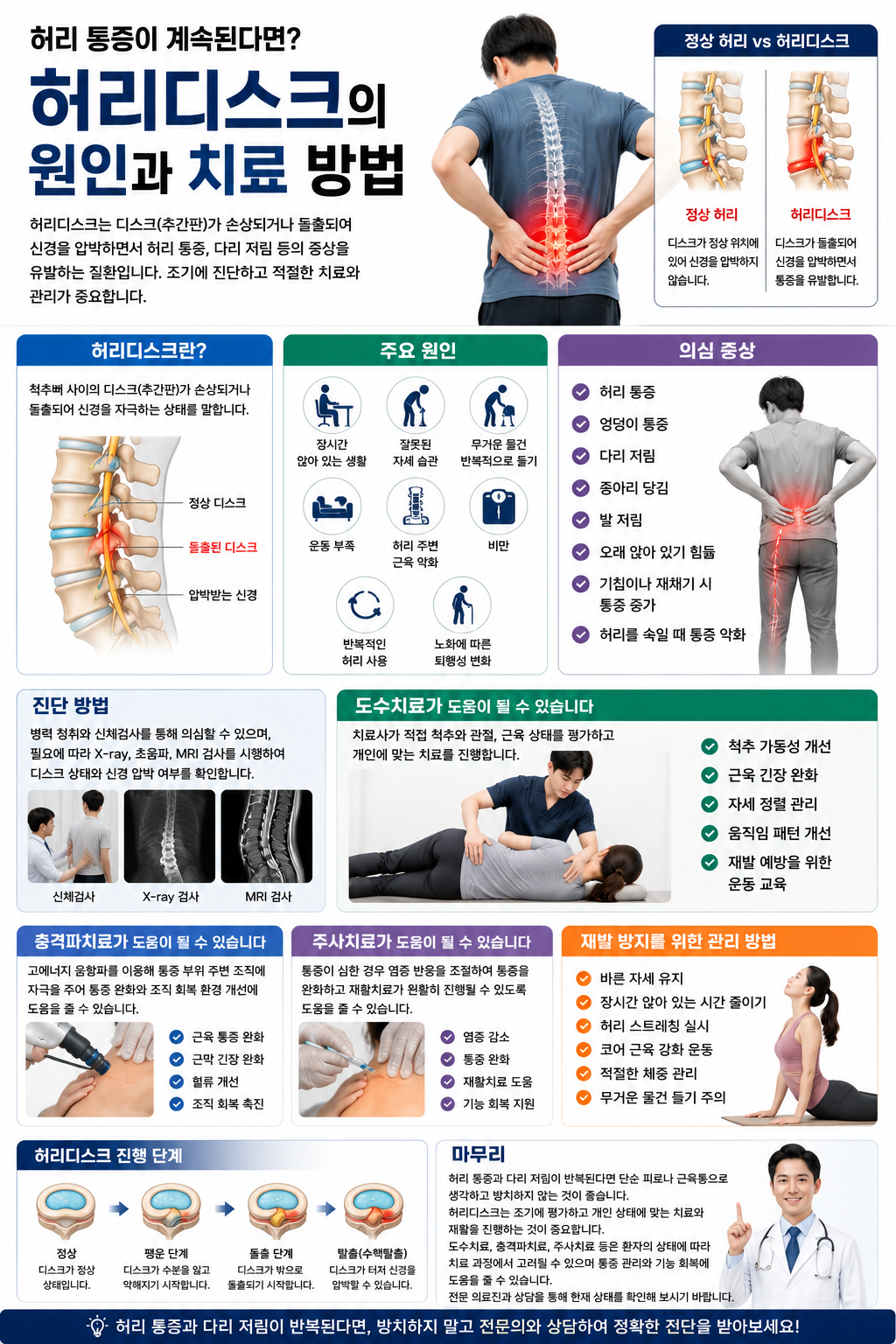
Between the vertebrae sit the discs (intervertebral discs). When a disc is damaged or pushes outward and irritates nearby nerves, it's called a herniated disc, or in medical terms, a lumbar disc herniation.
At first you may feel only back pain, but as the bulging disc presses harder on a nerve, leg numbness or altered sensation can follow. That's why back pain often begins after straining your back while lifting something heavy, or after a long stretch of mostly sitting. Since it's a common spinal condition today, it's important to start managing it early.
Why Does It Happen, and What Are the Symptoms?
A herniated disc usually develops from a combination of lifestyle habits and degenerative changes rather than a single cause.
- Sitting for long periods and poor posture
- Repeatedly lifting heavy objects or doing work that uses the back repeatedly
- Weak muscles around the lower back from lack of exercise
- Obesity and age-related degenerative changes
These days it's not uncommon in young office workers and students, either. Symptoms vary with how much the nerve is compressed, and if several of the following overlap, a herniated disc is worth considering.
Diagnosis Starts With Your History and a Physical Exam
Whether you have a herniated disc is first assessed through a medical history, asking when and how the pain started, and a physical exam. If needed, X-rays, ultrasound, or MRI are added to check the condition of the disc and how much the nerve is compressed. An accurate diagnosis is what makes it possible to build a treatment plan tailored to you.
What Role Do Manual Therapy, Shockwave Therapy, and Injections Each Play?
People with a herniated disc often also have imbalances in the pelvis and surrounding muscles, not just the lower back. So treatment is usually a combination tailored to your condition rather than a single approach.
- Manual therapy: A therapist directly assesses the condition of your spine, joints, and muscles, then tailors treatment to your function. The goals are improving spinal mobility, easing muscle tension, aligning posture, improving movement patterns, and teaching exercises to prevent recurrence.
- Shockwave therapy: A non-surgical treatment that uses high-energy acoustic waves to stimulate the tissue around the painful area. It doesn't eliminate the herniated disc itself; it's used to manage pain and improve conditions for recovery when there's also tension in the muscles around the lower back, myofascial pain, or soft tissue pain.
- Injections: Considered when pain is severe or nerve irritation symptoms persist. They help control inflammation and pain so you can keep up with rehabilitation.
Which treatments to use is decided by looking at your symptoms and test results together, and correcting posture and daily habits is an essential part as well.
Care to Continue After You Feel Better
If you stop managing it once the pain subsides, the risk of recurrence remains. In daily life, keep these in mind:
- Maintain good posture and cut down on sitting time
- Do back stretches and core-strengthening exercises
- Manage your weight
- Be careful when lifting heavy objects
Key Takeaways
- If back pain comes with leg numbness, don't dismiss it as simple muscle pain; check for a herniated disc.
- After diagnosis, manual therapy, shockwave therapy, injections, and other treatments are chosen based on your condition.
- Keeping up with posture and exercise after the pain eases helps prevent recurrence.
If recurring back pain is getting in the way of daily life, consider checking your current condition with a medical professional.
Last reviewed: 2026-10-07 This article provides general medical information. Individual diagnosis and treatment plans are determined through an in-person consultation.