
Greater Trochanteric Pain Syndrome: Hip Pain When Lying on Your Side
If the outside of your hip hurts when you lie on your side, it may be greater trochanteric pain syndrome; relieving pain and restoring movement are both key.
If you often wake up at night with a sharp pain on the outside of your hip after rolling onto one side, the pain may come from greater trochanteric pain syndrome. Following the questions most often asked by people in Seocho and Bangbae who struggle with hip pain, we explain what this condition is and how it's treated.
What is greater trochanteric pain syndrome?
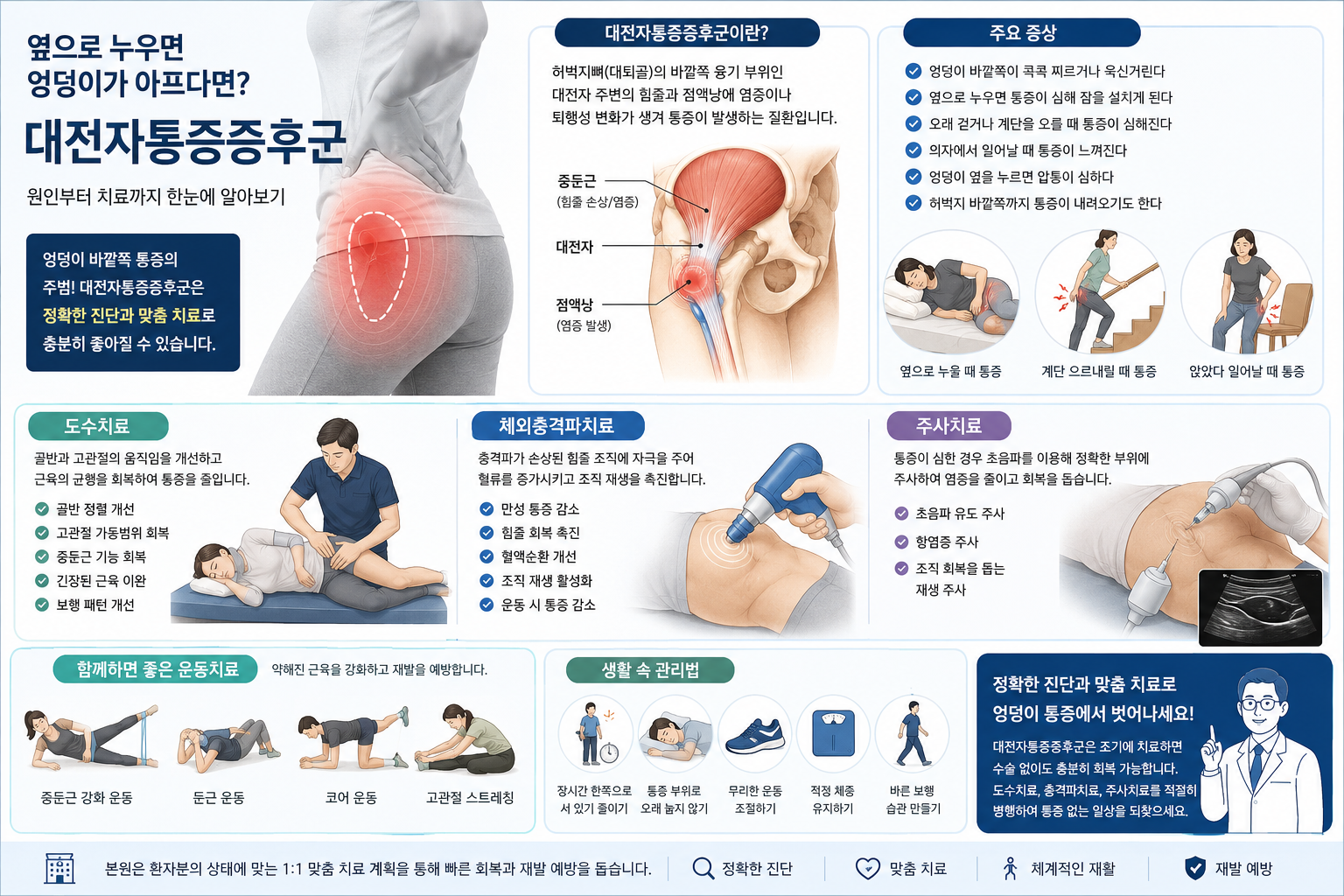
The bony bump on the outer side of the thigh bone (femur) is called the greater trochanter. Pain that develops around this area is collectively called greater trochanteric pain syndrome (GTPS).
It used to be explained simply as bursitis, but recent research has broadened the concept to include inflammation and degenerative changes in the gluteus medius and gluteus minimus tendons, as well as tendon damage. It's more accurate to think of it not as a single inflammation but as a condition in which repeated irritation reduces the function of the tendons and surrounding tissue, causing ongoing pain.
How is it different from a herniated disc in the lower back?
It's easily mistaken for a lumbar herniated disc or a hip joint condition, but in many cases the real problem is the tendons and bursa on the outside of the hip. If the following symptoms keep recurring, greater trochanteric pain syndrome may be the cause:
- A stabbing pain on the outside of the hip
- Waking up from pain when lying on your side
- Pain that worsens after long walks or hiking
- Discomfort going up or down stairs or getting up from a chair
- A sensation of pain running down the outside of the thigh
- Marked tenderness when pressing on the side of the hip
On the other hand, numbness reaching the toes or reduced sensation, as with a herniated disc, is relatively uncommon, and this is a clue that helps tell the two apart.
Why does it happen?
It develops from a combination of factors:
- Weak gluteus medius and minimus muscles, tight muscles around the hip
- Pelvic imbalance, leg length differences, poor walking habits
- Frequent stair climbing, jobs that require standing for long periods, overexercising
- Obesity, degenerative changes
It's relatively common in women and tends to increase after middle age.
How are diagnosis and treatment carried out?
We pinpoint the location of the pain through your medical history and a physical exam, and add X-ray, ultrasound, or MRI (if needed) when appropriate. Ultrasound is useful for checking tendon damage and the condition of the bursa, and it also helps distinguish this condition from others.
When we look closely at the cause, misaligned pelvic and hip movement is more often involved than inflammation alone. That's why manual therapy matters not just for reducing pain but for restoring movement itself. Shockwave therapy can be performed without surgery, and using ultrasound for injections lets us see the painful area and inject precisely at the right spot. Exercise progresses step by step according to each person's condition.
What should I be careful about in daily life?
- Avoid standing for long periods with your weight on one side
- Avoid lying on the painful side for long
- Moderate strenuous hiking and running
- Stretch before and after exercise, maintain a healthy weight, and walk with good form
To Sum Up
If you treat pain on the outside of your hip as simple muscle soreness, it can become chronic and make daily life even harder. With greater trochanteric pain syndrome, the key is treatment that identifies the cause and restores function. If your hip hurts every time you lie on your side, get a diagnosis instead of putting up with it.
Last reviewed: 2026-10-07 This article provides general medical information. Individual diagnosis and treatment plans are determined through an in-person consultation.