

Sensory Integration Therapy Near Seocho Station: Assessment to Therapy
Not all restlessness is a sensory issue, but if the same patterns keep repeating and disrupt daily life, it's time to look at sensory processing.
A child who can't sit still, a child startled by the smallest sound, a child who keeps falling and bumping into things at the playground. If you've wondered whether this is just personality or a difference in sensory processing, here's an overview of how assessment and Sensory Integration Therapy work at our child Development Center near Seocho Station. Not all restlessness is a sensory issue, but if the same behaviors keep repeating and make daily life harder, it's worth taking a look at how your child responds to sensory input.

What to Look At Before Chalking It Up to Personality
At first, most parents figure it's just how kids are. They see it as temperament or personality and wait, hoping it will improve as the child grows.
Then things change once the child starts daycare or school, and issues like trouble staying focused or difficulty with peers start to show. That's when parents begin to worry that something may be wrong and think about a consultation at a child development center. What's needed at this point is to sort out whether it's a difference in personality or a difference in how the child responds during development. If the same behaviors keep repeating or keep causing problems in daily life, we also look at how the child responds to sensory input.

The Senses Work Together, Not Separately
Children take in many kinds of sensory information at the same time.
These senses connect with one another and show up as a single behavior. Even simple movements like walking and running draw on balance, muscle control, and visual information all at once, and play adds spatial judgment and timing on top of that.
When these connections don't run smoothly, sensory information may not get organized properly, which can show up like this:
- Reacts strongly even to small stimuli
- Is unusually sensitive to certain sounds or textures
- Is bothered by fabrics or sounds
- Barely reacts after falling or bumping into things
- Keeps moving and seeking stimulation
Sensory processing isn't about a single behavior. It's tied to the whole process of how the brain integrates and interprets many kinds of sensory information.

What Does a Sensory Integration Assessment Look At?
Sensory Integration Therapy at our Development Center near Seocho Station starts with a sensory integration assessment. Using a sensory modulation test, the Denver Developmental Screening Test, a parent interview, and clinical observation, we look at the child's sensory responses together with their everyday behavior.
The assessment covers a lot of ground. Beyond how the child responds to sensory input, we look at sustaining attention, regulating behavior, and adapting to changes in their environment. When needed, we also look at areas directly tied to daily life, such as motor planning, body coordination, visual perception, fine motor skills, and use of tools.
Because sensory processing involves many functions working at once, it's important to understand the whole picture rather than pin it on one problem. The assessment shows specifically whether a child tends to be over-sensitive or under-responsive to sensory input, or has difficulty with controlling and carrying out movements.
Play-Based Sensory Integration Therapy
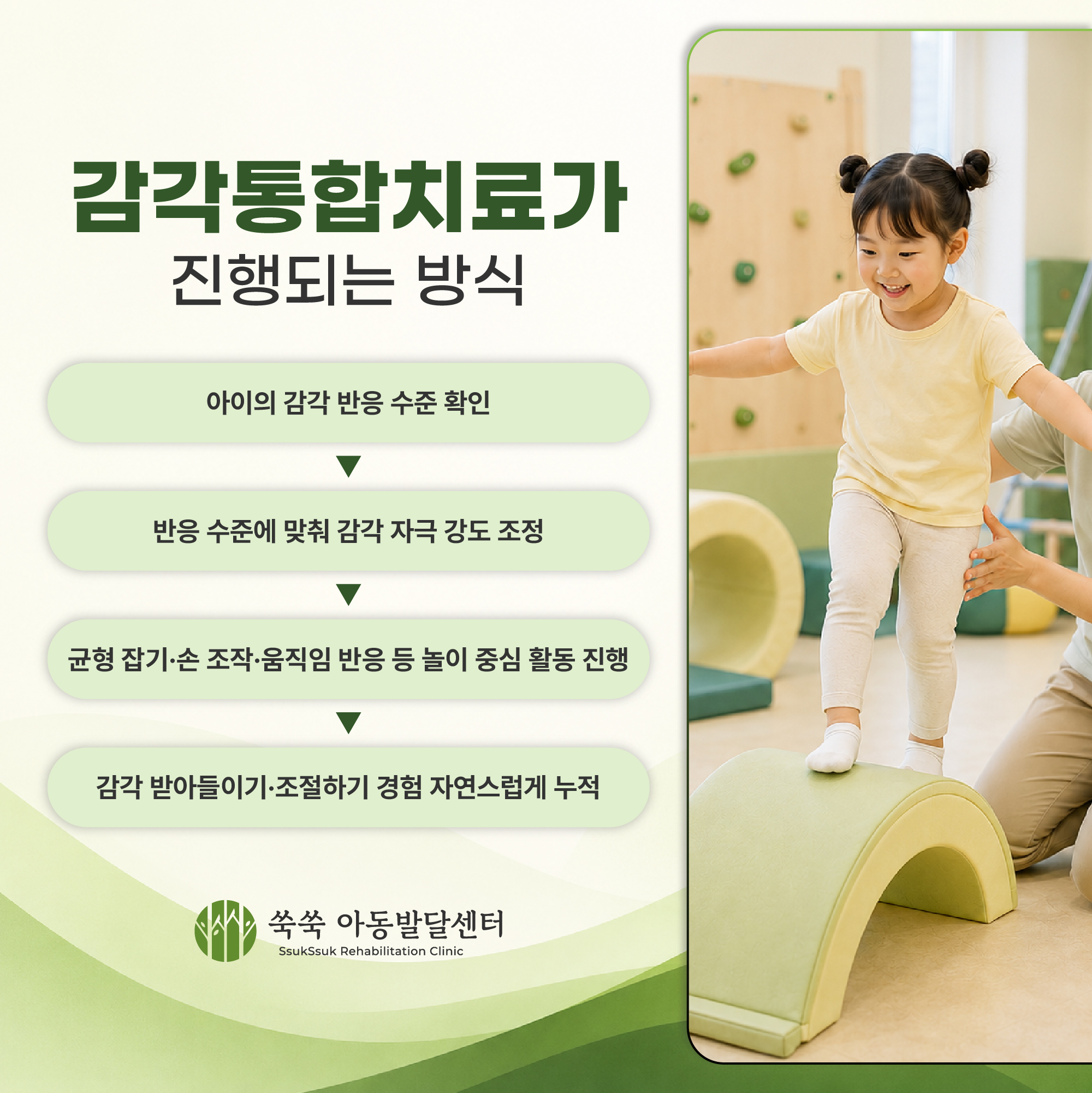
Once the assessment identifies a child's sensory profile, we begin Sensory Integration Therapy tailored to it. Sensory Integration Therapy helps a child take in and regulate sensory information, including sight, sound, and touch, in a way that works for them.
Therapy is built around play, with a variety of sensory experiences woven in naturally. Play such as balancing, hands-on activities, and moving and responding becomes an experience of taking in and regulating the senses.
What matters is not the amount of sensory input but the level. The same activity can be too much for one child and just right for another, so we adjust each step based on how the child responds.

How to Approach Behavior That Seems Clumsy
There's no need to see every bit of restlessness or clumsiness as a sensory problem. But if similar patterns keep repeating and everyday adjustment stays difficult, it can help to check where your child's sensory processing is right now. Sensory development happens naturally as children grow, but how and how fast they respond differs from child to child. Simply understanding how your child takes in and reacts to their environment can change the course of their development going forward.
Last reviewed: 2026-10-07
This article provides general information only. Your child's developmental needs and treatment plan are determined through consultation and assessment.