

Orthopedic Care in Seocho: Why Tight Shoulders Keep Coming Back
If shoulder tightness keeps returning, look at posture and movement patterns before the muscle itself; the right treatment depends on the cause.
If your shoulders loosen up only to tighten again, it's worth looking first at the posture and movement patterns that keep those muscles under tension, not just the muscles themselves. Following the situations Dr. Lee Soo Jin, Director of Ssukssuk Rehabilitation Medicine Clinic, often explores in consultations, this article explains why shoulder tightness keeps recurring and how evaluation and treatment work.

What Comes Up in Consultations
When people first notice tight shoulders, they usually chalk it up to fatigue. They assume they slept wrong or sat too long and try to get by with stretching or massage, but many find the same spot tightening again and again, and even more often over time.
As we talk, it often turns out the problem isn't just the shoulder. Patients mention that their shoulders sit at different heights, that their weight feels shifted to one side, or that their back stiffens easily because they sit for long hours. That's why shoulder tightness calls for looking at the environment and movements in which it keeps recurring.

Posture Keeps Your Shoulder Muscles From Resting
The muscles around the shoulder are heavily influenced by posture and movement. When your head juts forward or your upper back rounds for long stretches, these muscles stay constantly tense. At first it's just stiffness, but when the strain builds up in one place, it becomes hard to relieve.
Habits like carrying things on one side or leaning in one direction while sitting also disturb left-right balance. They may not be noticeable right away, but over time they show up as tightness that keeps coming back.
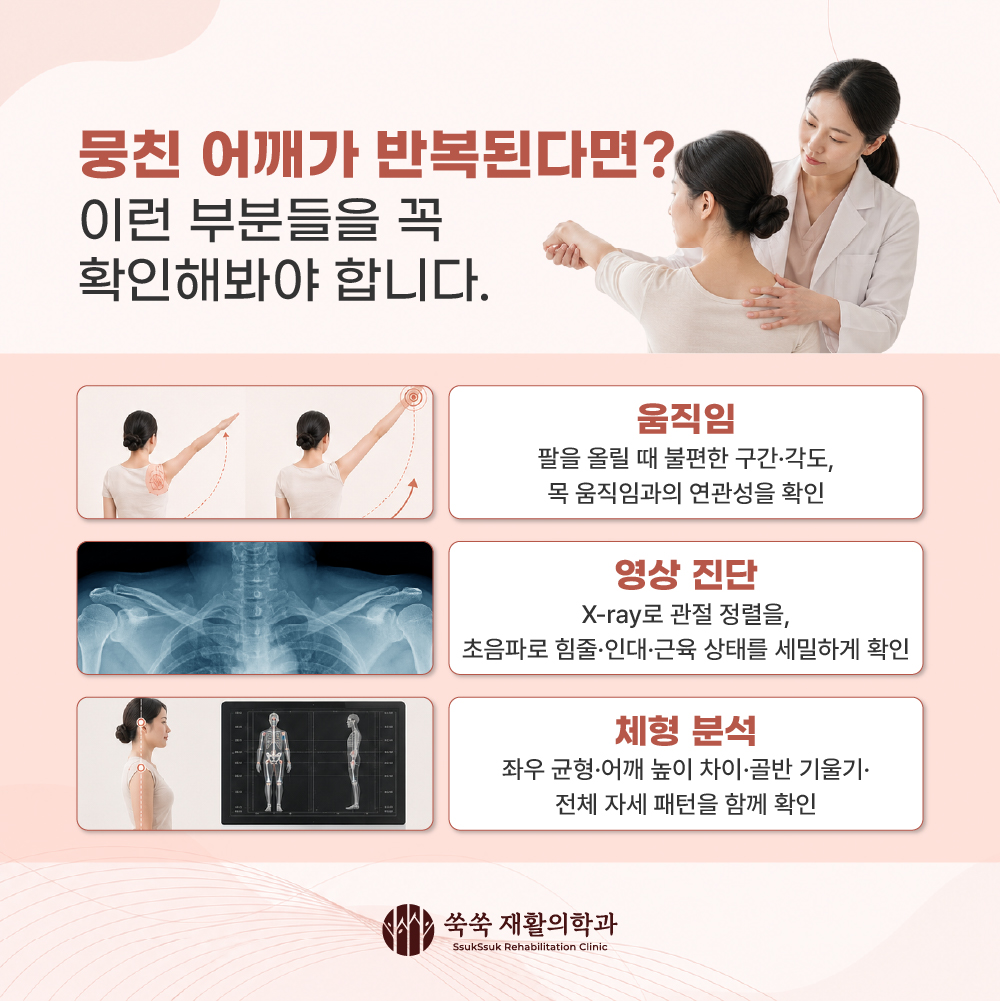
Recurring Tightness Requires Looking at the Whole Body
The shoulder may look like a single joint, but it's a system in which the neck, upper back, shoulder blade, and many muscles move together to stay balanced. So it's hard to explain the cause just by examining the tight spot. During an exam, we look for clues like these:
- At what point in raising your arm it becomes uncomfortable
- Whether tightness is worse only at certain angles
- Whether moving your neck changes your shoulder symptoms
When needed, X-rays show joint alignment and structural changes, while ultrasound gives a detailed look at the tendons, ligaments, and surrounding muscles. Imaging doesn't just rule problems in or out; it helps us judge how the shoulder moves and where the strain concentrates. A posture analysis may also be used to check left-right balance, differences in shoulder height, pelvic tilt, and overall posture patterns.
The purpose of this process is to understand not just "where it hurts" but "why strain keeps building up in this spot."

Treatment Chosen According to the Cause
There's no single right answer; the treatment depends on how we interpret the structure behind the recurring tightness.

Wrapping Up
- Tight shoulders may not be a problem you can fix by loosening them up once.
- If your posture and movement habits stay the same, strain will build up in the same spot again.
- Rather than temporary relief, the key to managing it is understanding both how you use your body and the structural strain involved.
Author: Dr. Lee Soo Jin, Director, Ssukssuk Rehabilitation Medicine Clinic (board-certified in rehabilitation medicine) · Profile Last reviewed: 2026-10-07 This article provides general medical information. Individual diagnosis and treatment plans are determined through an in-person consultation.