

Flat Feet and Knee Pain: How They're Connected
Flat feet can change knee alignment as the arch collapses, so if knee pain keeps coming back, your feet and gait should be checked too.
Your knee hurts, so why would we want to look at your feet? When your knees hurt going down stairs or the front of your knee aches after a long walk, most people suspect the knee first. But in rehabilitation medicine, we often check the shape of the feet and the way you walk as well, and flat feet are often at the center of it. Here's how flat feet can lead to knee pain and how to manage it.

Flat Feet Means a Low or Absent Arch
The arch of the foot distributes body weight and absorbs shock when you walk. Flat feet refers to an arch that is lower than normal or nearly absent. When the arch doesn't do its job, the foot easily collapses inward with each step, and the effect can spread to the alignment of the whole body, including the ankles, knees, and hips.
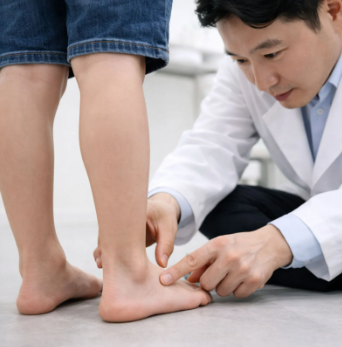
From Foot to Knee: The Three Steps That Lead to Pain
- The foot collapses inward: When you bear weight, the ankle tilts inward and can't disperse impact efficiently.
- Knee alignment changes with it: The shinbone rotates inward and the knee increasingly turns inward, placing repeated strain on the joint, ligaments, and tendons.
- The front of the knee starts to hurt: When the movement of the kneecap is affected and strain increases on the cartilage at the front of the knee and the surrounding tissues, knee pain can develop when going down stairs, standing up after sitting for a long time, or after a long walk.
Do All Flat Feet Need Treatment?
No. Not everyone with flat feet needs treatment. However, if flat feet come with problems such as foot pain, knee pain, frequent ankle sprains, or difficulty walking for long periods, it's a good idea to get evaluated. Watch for these signs:
- Your knees hurt when you walk for a long time
- The front of your knee aches when going down stairs
- The inner side of your shoes wears out first
- The soles of your feet tire easily
- Your feet and knees both hurt when you stand for a long time
Evaluation, Treatment, and Daily Care in Rehabilitation Medicine
We don't treat just the knee. We look at the condition of the arch, your gait, lower limb alignment, and strength and flexibility together to find the cause. Depending on your condition, we may recommend strengthening exercises for the foot and calf muscles, stretching, posture and gait correction, and, if needed, custom insoles. If symptoms are severe, medication or physical therapy may be added.
Flat feet themselves are hard to change completely, but daily care can reduce the strain on your knees.
- Stretch the soles of your feet and your calves
- Do exercises to strengthen the small muscles of the foot
- Manage your weight and wear shoes that fit your feet
- Take enough breaks when standing or walking for long periods
The Bottom Line
The cause of knee pain isn't always in the knee. If knee pain keeps coming back without a clear cause, have your foot shape and gait checked too. Even if you have flat feet, whether treatment is needed is decided by considering your pain and the degree of functional decline.
Last reviewed: 2026-10-07 This article provides general medical information. Individual diagnosis and treatment decisions are made during an in-person consultation.