

Speech Therapy at a Gwanak-gu Center: Language Assessment Tests
Speech therapy isn't a class that teaches talking. It's a process of understanding how a child uses language through assessment and broadening their communication.
It's easy to think of speech therapy as a class that teaches children to talk. In reality, it's a process of assessing how a child uses language and then broadening their understanding, expression, and communication to match. For parents looking into speech therapy at a child development center in Gwanak-gu, we've put together an at-a-glance comparison of the assessment tests and therapy approaches.

Similar worries, different patterns
There are a few things parents find most confusing during consultations: "They seem to understand, but they're late to talk." "They talk, but their expression seems behind other kids'." "I can't tell whether it's pronunciation or a language delay." These may sound like the same worry, but they can actually be quite different patterns. That's why we don't look only at how much or how fast a child talks; we also look at how they use language.
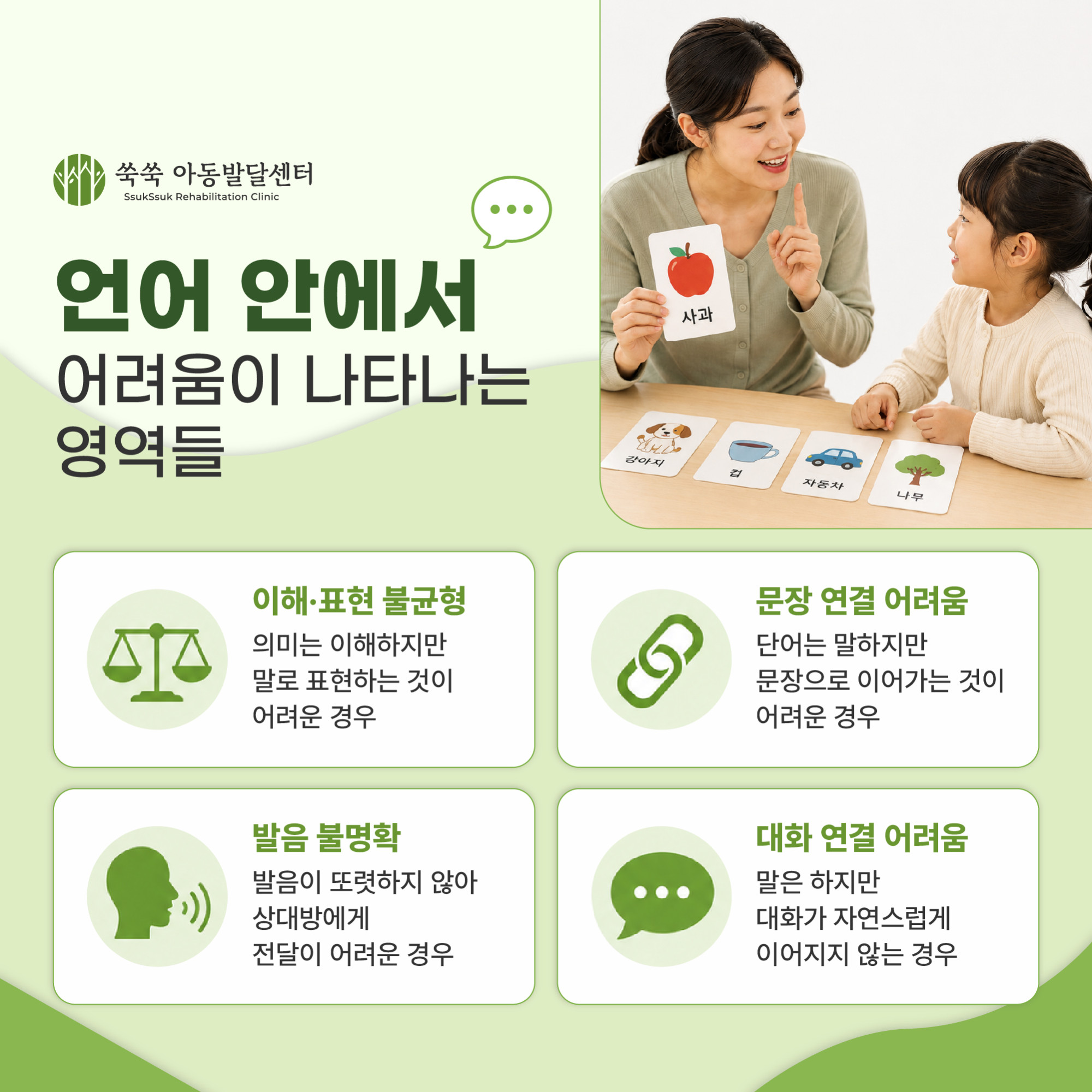
Even the same "talking" difficulty shows up in different places for different children.
- Knows the meaning but has trouble turning it into words
- Can say words but can't put them together into sentences
- Pronunciation isn't clear, so the meaning doesn't come across well
- Conversations don't flow naturally
Even when things look similar on the surface, the difficulty arises in different areas. So what we need to look at isn't how much a child talks, but how they use language.
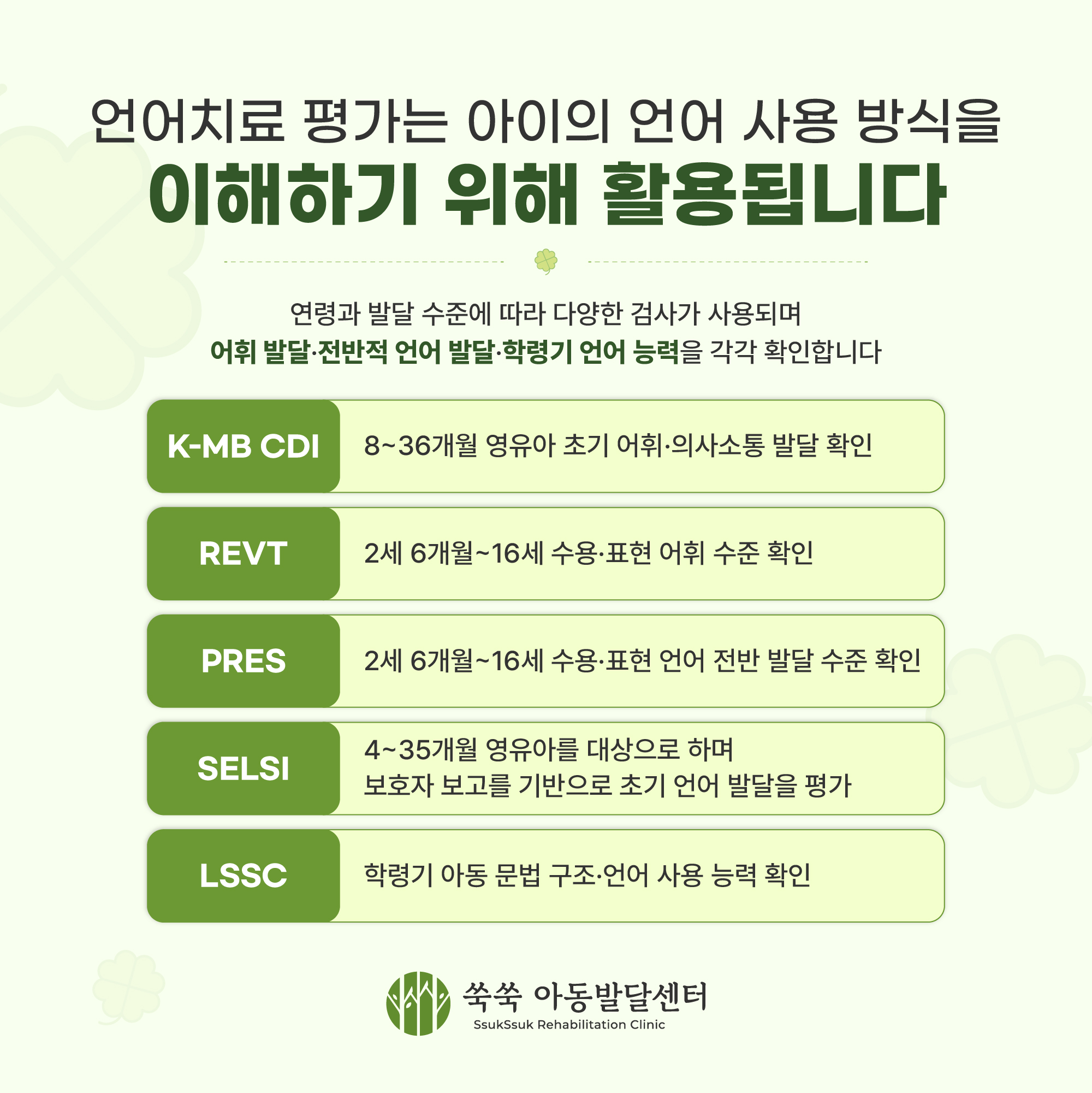
Language assessment tests at a glance
Language is hard to judge with a single yardstick, so different tests are used depending on age and developmental level. These are the language assessments used in speech therapy at our Gwanak-gu child development center.
In short, vocabulary development is assessed with the K-MB CDI and REVT, overall language development with the SELSI and PRES, and school-age grammar with the LSSC. Whichever test is used, the goal isn't just to check a score, but to understand how your child's language development is unfolding.

After the assessment, how does speech therapy differ for each child?
Once an assessment identifies a child's language profile, speech therapy begins. It looks at language as a whole, from pronunciation to understanding and expressing speech to social communication, and is individualized to the child's developmental level.
Sessions center on play and interaction and are designed so children encounter chances to communicate in their surroundings and experience language naturally. The goal isn't drilling words through repetition, but helping the ability to understand and express, along with communication skills, grow together.
The focus also shifts depending on where the child has difficulty.
- If pronunciation is unclear, articulation work becomes the focus.
- If both understanding and expression are weak, we build both skills together.
- If communication in social situations is hard, we add an interaction-focused approach.

Understanding comes before judgment
Differences in language development show up in many ways from child to child. Rather than jumping to conclusions because a child talks slowly or their pronunciation is unclear, it's important to first understand where their language development stands now. Language is a skill that grows little by little through repeated experiences of understanding, expressing, and communicating. Checking your child's stage of language development not only eases worry but also becomes the starting point for planning what comes next.
Last reviewed: 2026-10-07
This article provides general information. Your child's developmental status and treatment plan are determined through consultation and assessment.