

Speech Therapy at a Daechi Development Center: Building Communication
Speech therapy isn't just practice saying words. It builds on your child's existing communication skills to expand how they express themselves and connect with others.
If your child talks well enough but conversations don't keep going, might they still need speech therapy? Many parents who come to us for speech therapy consultations at our Daechi child development center aren't worried that their child can't talk. They're worried about how their child communicates. The child may seem to struggle to put what they want into words, or may seem to fall short in communication when playing with peers. Here, in question-and-answer order, is what speech therapy looks at and how it builds communication skills.

Can a child who talks still need speech therapy?
When people think of language development, it's easy to focus first on how many words a child says or how quickly they form sentences. But language also includes listening to and understanding others, expressing one's own thoughts and feelings, and communicating while building relationships with other people. So the fact that a child can talk doesn't by itself mean language development is progressing evenly.
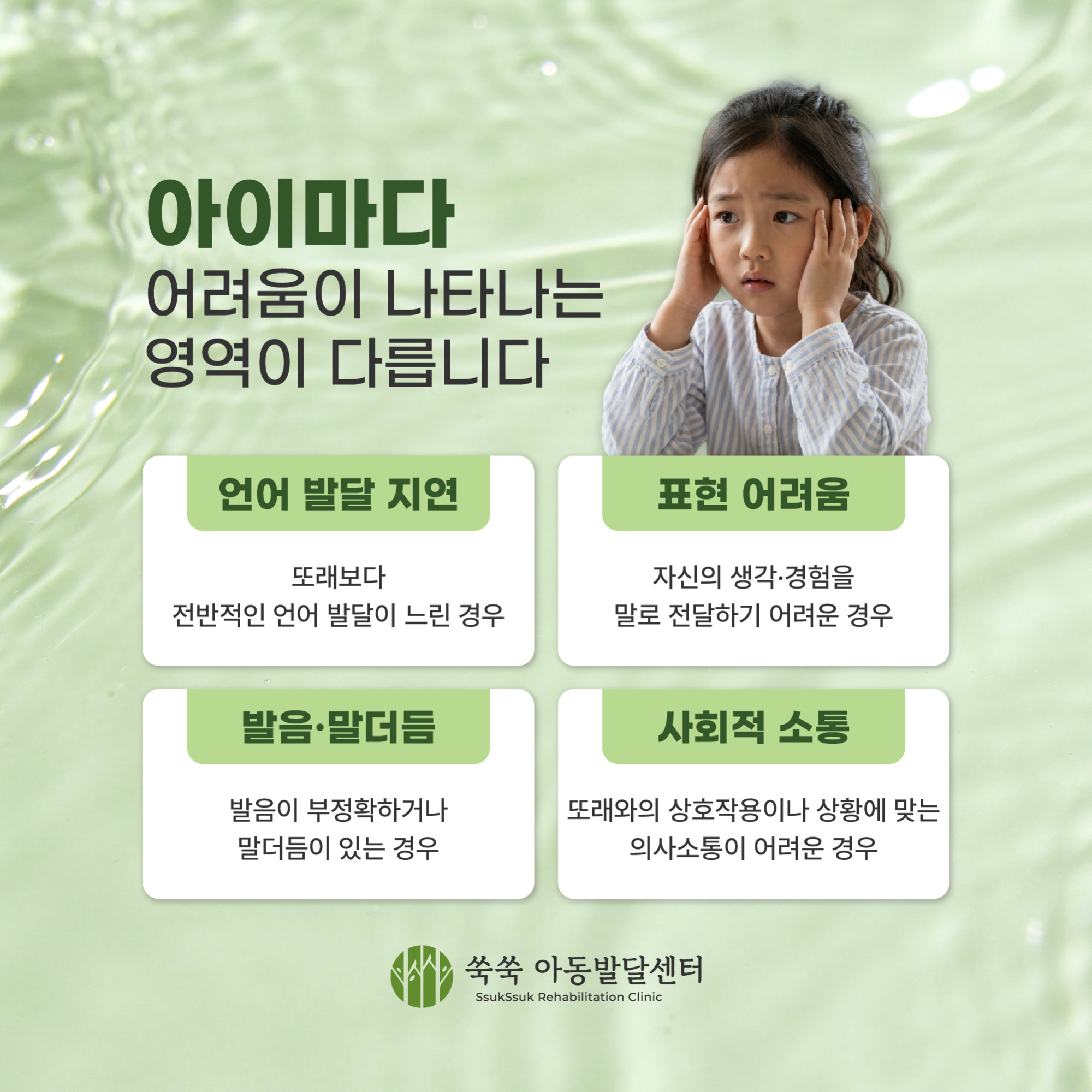
Which children can speech therapy help?
Speech therapy is a process of assessing children who have difficulty with speech and language, finding what they need right now, and building their communication skills in the right direction. Where the difficulties show up differs from child to child.
- Overall language development is slower than peers'
- Has trouble putting thoughts or experiences into words
- Pronunciation is unclear, or the child stutters
- Has difficulty interacting with peers or with social communication
Even when language problems look alike, the help a child needs can differ. Language is a tool for sharing thoughts and feelings, and it's also the foundation for building friendships and learning new things. That's why we see speech therapy not as practice producing words, but as a process of building communication skills as a whole.
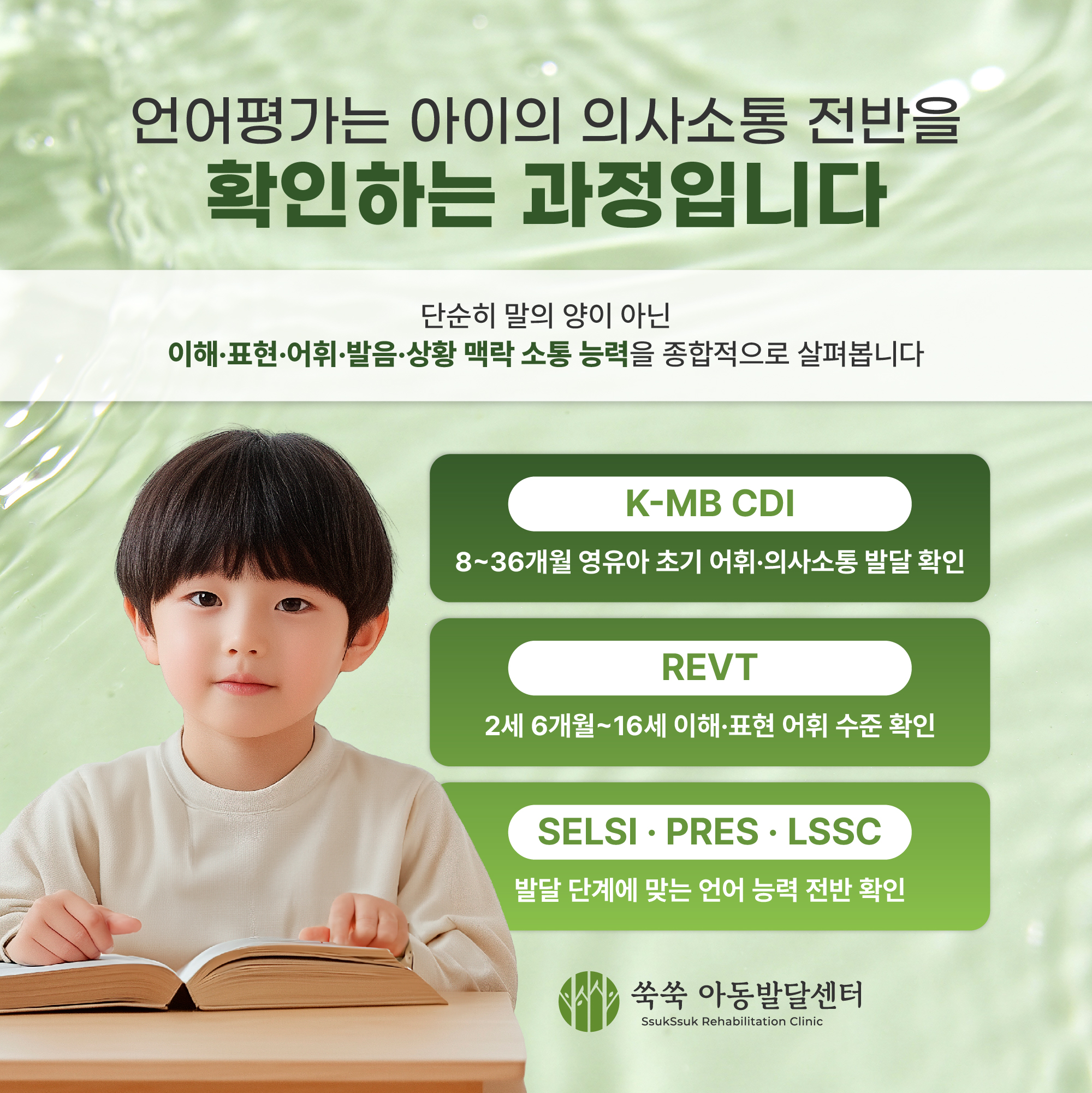
What does a language assessment look at?
To see those differences, we first need to assess the child's current language skills. A language assessment doesn't look at how much a child talks. It looks at all of the following together:
- Ability to understand speech
- Ability to express thoughts
- Vocabulary level
- Pronunciation and speech sound production
- Ability to communicate appropriately for the situation
The tests used also differ by age and developmental level. Early vocabulary and communication development in infants and toddlers aged 8–17 months and 18–36 months is checked with the K-MB CDI (Korean MacArthur-Bates Communicative Development Inventories), and receptive and expressive vocabulary from age 2 years 6 months to 16 years with the REVT (Receptive & Expressive Vocabulary Test). We add the SELSI (Sequenced Language Scale for Infants), PRES (Preschool Receptive-Expressive Language Scale), and LSSC (Language Scale for School-aged Children) to look at language skills appropriate to each developmental stage. Based on these results, we plan the language stimulation and therapy direction your child needs.

How does therapy differ from child to child?
Once an assessment identifies a child's language profile, we set the direction for speech therapy. Not every child is treated the same way.
- A child who first needs to build understanding of what others say
- A child who needs more experience expressing their own thoughts
- A child who needs to work on producing speech sounds accurately
- A child who needs practice communicating appropriately in conversations and interactions with peers
In every case, speech therapy centers on play and interaction, helping children experience and use language in natural situations. The key is not repeating set phrases, but building up experiences of expressing themselves and communicating on their own.

When it's time to check rather than wait
Language development isn't only about learning to talk quickly. It's a developmental process children need in order to express thoughts and feelings, build relationships with others, and adjust to new environments. If you sense your child is having difficulty with language, it may be worth finding out which area is hard for them now, rather than only waiting.
Speech therapy doesn't stop at filling gaps. It builds on the communication skills your child already has to help them express themselves more smoothly and build relationships. Every child develops at a different pace and needs a different direction, so understanding where your child is right now is the starting point for what comes next.
Last reviewed: 2026-10-07
This article provides general information. Your child's developmental status and treatment plan are determined through consultation and assessment.