
Prolotherapy Near Bangbae Station: Helping Weakened Ligaments and Tendons
Hello, I'm Dr. Lee Soo Jin, Director of Ssukssuk Rehabilitation Medicine Clinic. "It was fine at first, but now it hurts more and more often."
Prolotherapy | Rehabilitation medicine near Bangbae Station
Hello, I'm Dr. Lee Soo Jin, Director of Ssukssuk Rehabilitation Medicine Clinic.
"It was fine at first, but now it hurts more and more often."
"It seems to get better when I rest, but then it bothers me again."
These are things we often hear from patients who come in with recurring pain.
At first, it's easy to assume it's just fatigue from overuse. You may expect it to improve with enough rest or less use, but if discomfort keeps returning to the same area over time, simple muscle fatigue may not explain it.
Pain that keeps recurring around a joint in particular may be related not only to the muscles but also to the condition of the ligaments and tendons that keep the joint stable.
When repetitive use and small injuries accumulate, these tissues can't recover as fast as they're being strained, and they may stay in a weakened state. Prolotherapy is one treatment option considered to support the healing of these ligaments and tendons.
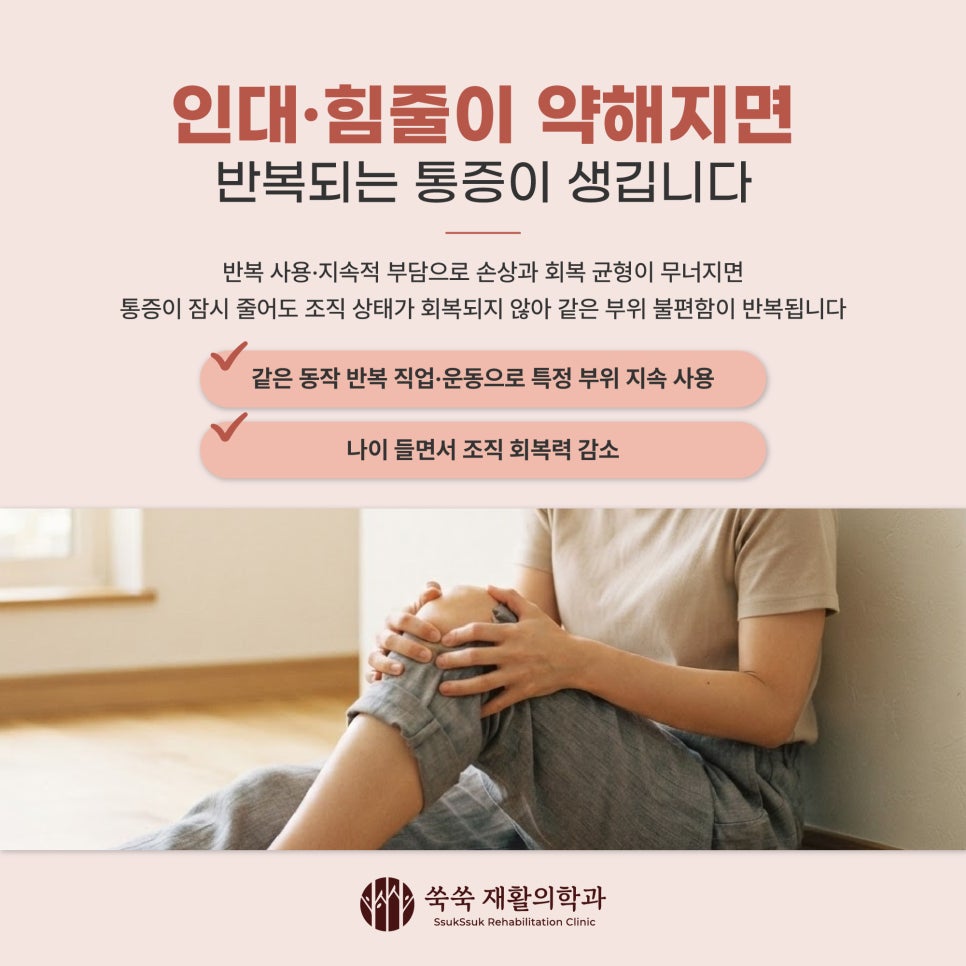
Prolotherapy | Rehabilitation medicine near Bangbae Station
What Happens When Ligaments and Tendons Weaken?
Ligaments and tendons play an important role in keeping our joints stable and moving.
Ligaments connect bone to bone so joints can move stably, while tendons transfer muscle force to bone to create movement.
But with repeated use or ongoing strain, small injuries can develop in these tissues.
For example, in jobs that involve repeating the same motion, in sports that place continuous demands on a specific area, or as tissue healing capacity declines with age, the balance between damage and repair can break down.
In these cases, even if the pain seems to ease for a while, discomfort in the same area can keep returning if the underlying tissue doesn't recover.
That's why, with recurring pain, it's important not only to reduce the pain but also to check the current condition of the tissue.
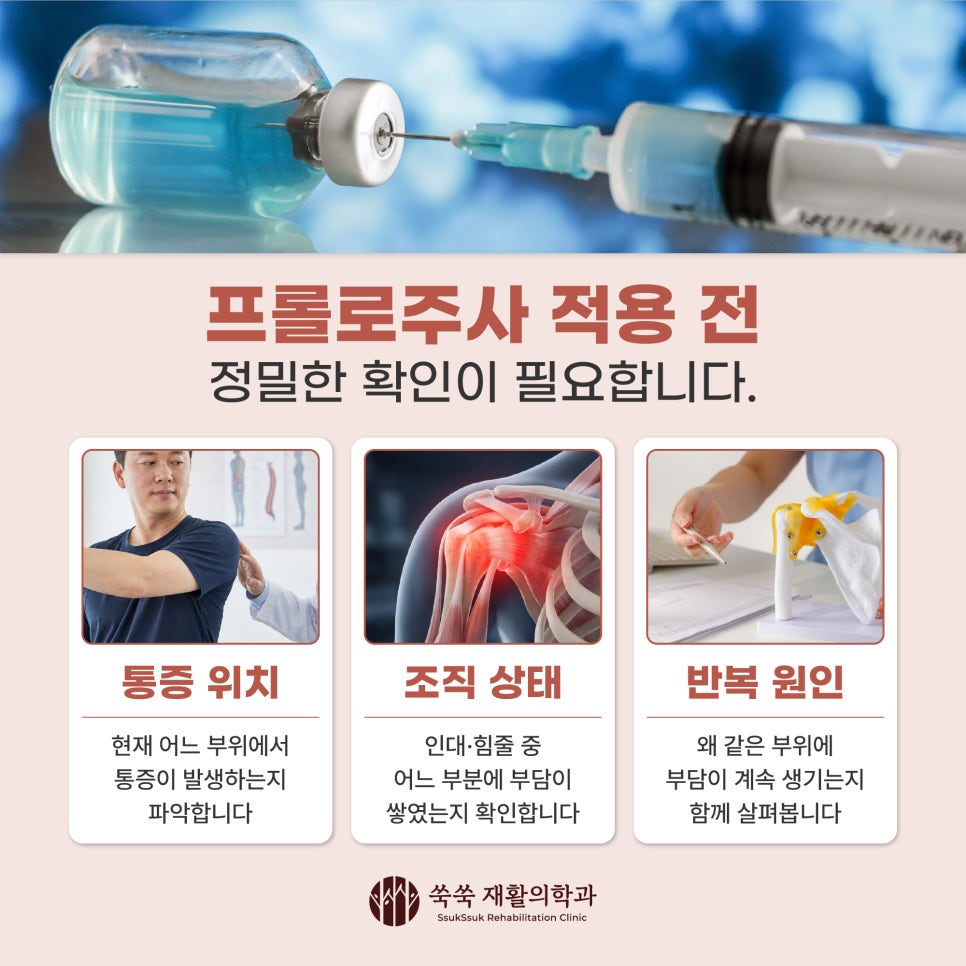
Prolotherapy | Rehabilitation medicine near Bangbae Station
How Does Prolotherapy Work?
Prolotherapy involves injecting a treatment solution into weakened ligaments and tendons to stimulate the body's own healing process.
When the right stimulus is delivered to damaged tissue, the body begins a response to repair that area. The basic idea of prolotherapy is to use this principle to support the tissue's healing process and help the weakened area function more stably.
However, prolotherapy isn't simply about injecting wherever it hurts. Whether it's appropriate is decided only after checking where the pain is coming from, which tissues are under strain, and what's causing it to recur.
Prolotherapy | Rehabilitation medicine near Bangbae Station
When Might Prolotherapy Be Considered?
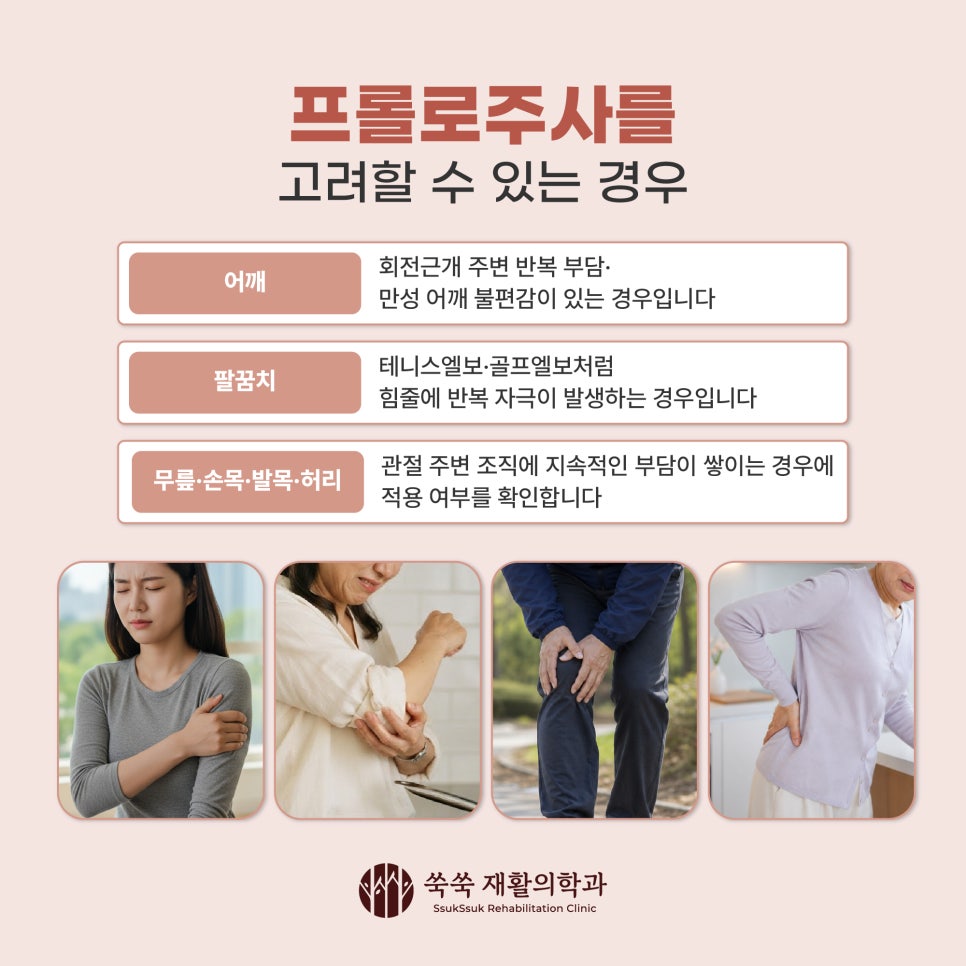
Prolotherapy is mainly considered when strain has built up around ligaments and tendons due to repetitive use.
In the shoulder, it may be considered for repeated strain around the rotator cuff or chronic shoulder discomfort.
In the elbow, it may be used for conditions involving repeated irritation of the tendons, such as tennis elbow or golfer's elbow. It may also be considered for areas where ongoing strain builds up in the tissues around joints, such as the knee, wrist, or ankle.
For ligament-related pain around the lower back, where weakness of specific tissues is linked to repeated strain, a treatment approach may also be considered depending on the condition.
But even pain in the same area can have different causes, and prolotherapy isn't applied the same way to every type of pain. That's why it's important to check the current condition of the tissue and the cause of your symptoms before choosing the right treatment approach.
Prolotherapy | Rehabilitation medicine near Bangbae Station
The Recovery Process After Treatment Matters Too
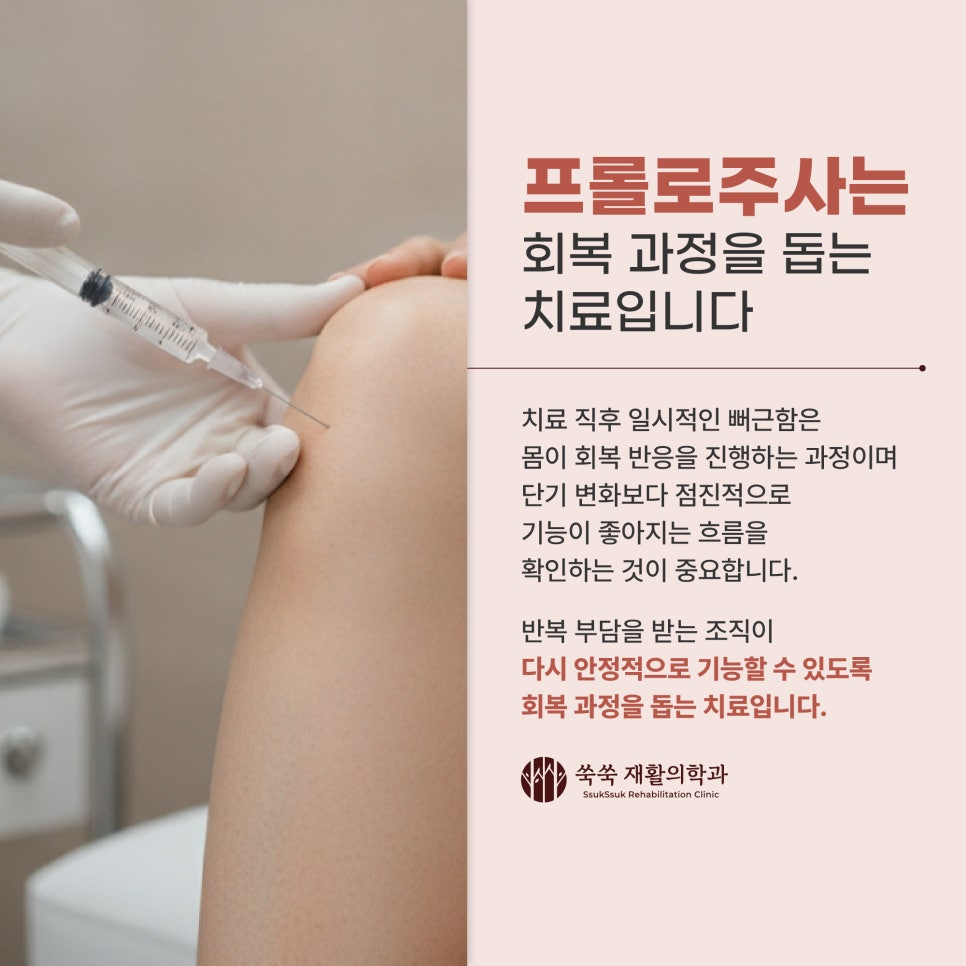
Prolotherapy isn't a treatment where all discomfort disappears right after the injection.
As the tissue heals, you may temporarily feel some stiffness or discomfort. This can be part of the body's healing response.
In general, it's best to avoid overloading the treated area for a few days after the injection, including strenuous exercise and repetitive use. And because tissue takes time to heal, it's important to look at gradual improvement in function rather than only short-term changes.
You can think of prolotherapy not as a treatment that temporarily reduces pain, but as one that supports the healing process so tissues under repeated strain can function stably again.