

Bangbae Station: Late Talking and Developmental Disability
A developmental disability isn't determined by late talking alone—we look at language, cognition, motor skills, social skills, and adaptive skills together.
Being late to talk doesn't automatically mean a developmental disability. Watching other kids the same age speak in sentences and share their thoughts, it's easy to worry that your child is on a different path—but language delay and developmental disability are not the same thing. Here's what our development center near Bangbae Station looks at when considering whether a developmental disability may be present.

Language delay vs. developmental disability: different scopes
Some children are late to talk yet understand others well and interact smoothly during play. On the other hand, some children seem to use plenty of words but have trouble expressing their thoughts or communicating in ways that fit the situation. That's why, rather than focusing on the single snapshot of "late to talk," it's important to look at the whole course of development—how your child is communicating and growing right now.

Language development: what to look at besides word count
When checking language development, we don't stop at how many words a child says. Language ability can be looked at in three parts: receptive, expressive, and pragmatic language.
- Receptive language — the ability to understand what others say. We look at whether your child responds appropriately to phrases like "Bring me the toy" or "Let's put on your shoes," and whether they grasp the meaning of what people around them say.
- Expressive language — the ability to put thoughts and needs into words. This includes how many words they use, how they build sentences, and how they express experiences and feelings.
- Pragmatic language — the ability to use language in real situations. We look at whether your child takes turns in conversation, chooses expressions that fit the situation, and shares interests with others.
Two children may both look language-delayed, yet one struggles with expression while the other struggles with understanding or communication. That's why we need to look at the whole process of language development, not just the amount of speech.
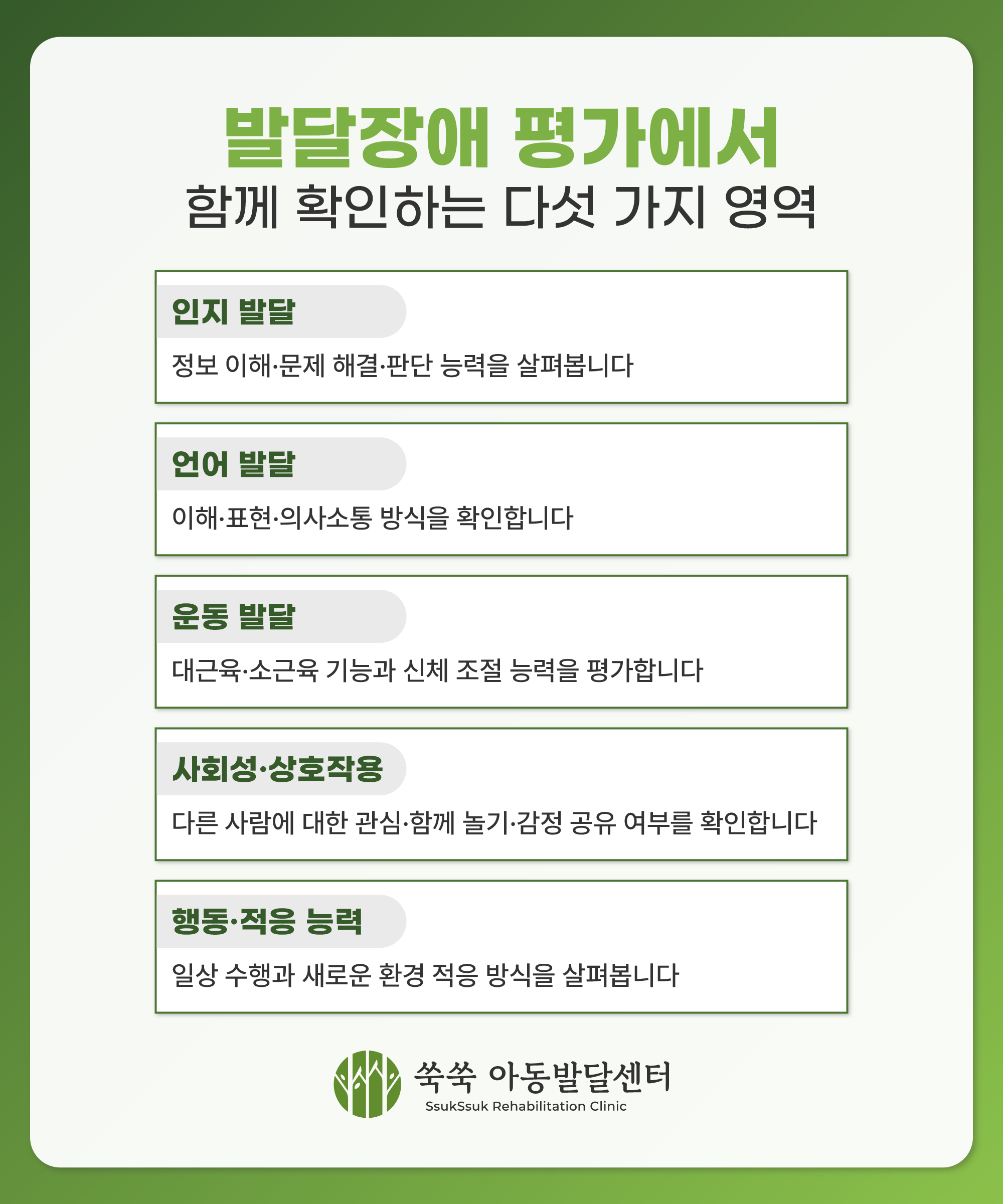
We look at five areas together
We don't judge whether a developmental disability is present from one particular behavior. Understanding your child's current developmental level means looking at several areas as a whole.
In the infant and toddler years, areas of development influence one another, so if only language seems delayed, checking language alone may not be enough. The Bayley Scales of Infant and Toddler Development (Bayley) is one example. It looks at cognitive, language, motor, social-emotional, and adaptive behavior in children from 1 to 42 months to help identify current developmental level and what kind of support is needed.
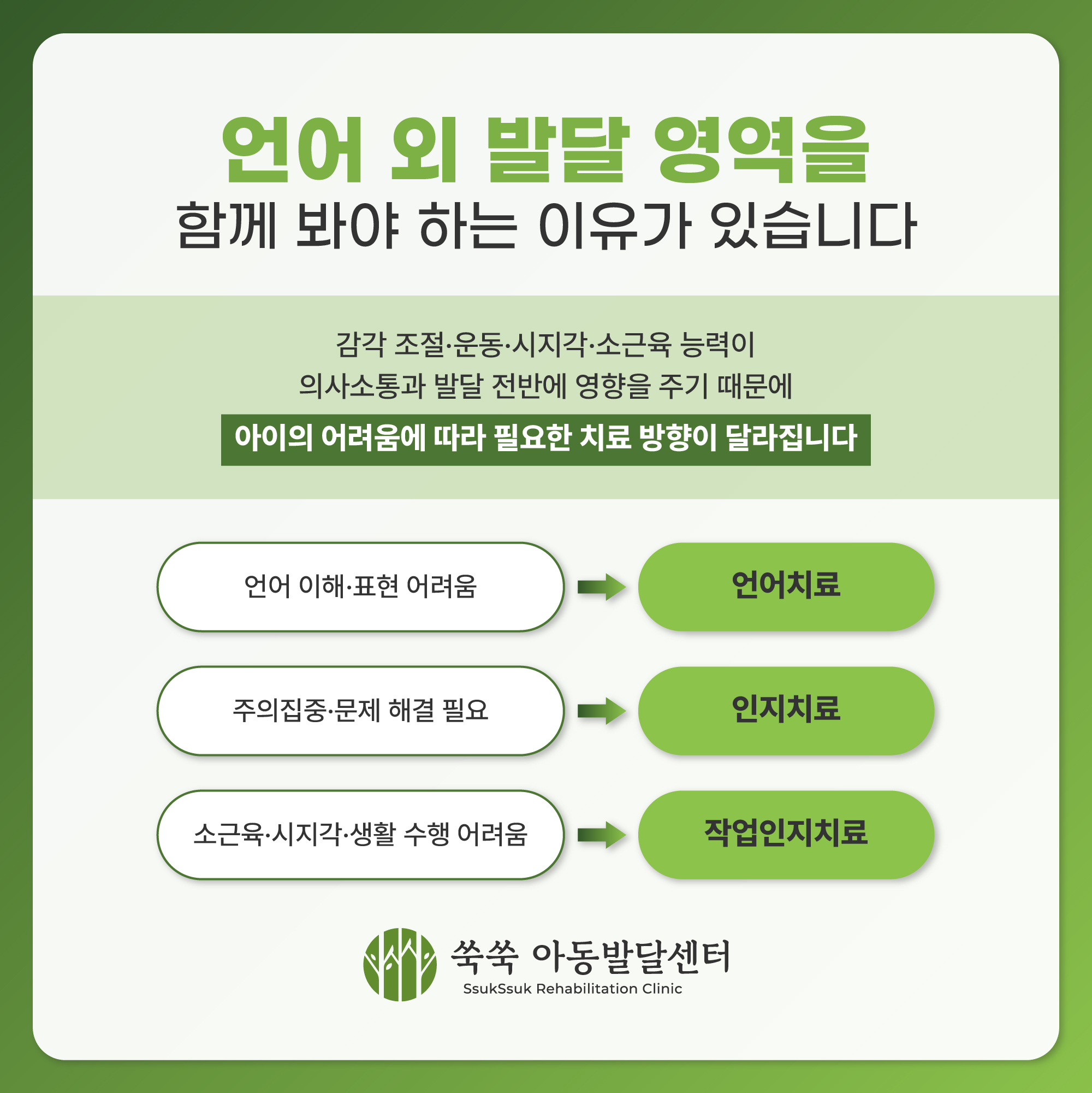
Senses and movement affect communication too
Language doesn't develop on its own—it grows alongside many other abilities. The ability to take in and regulate sensory information, to move and use the body, and the experiences built through play can all affect communication and development.
Some children react strongly to certain sounds or textures, while others constantly seek out sensory input. Some also have difficulty planning and carrying out movements, with body coordination, with visual processing, or with fine motor skills. A sensory integration assessment can check sensory regulation, motor planning, body coordination, visual-perceptual processing, and tool use together.
The right direction depends on the assessment results.
- If expressing or understanding language is hard → Speech Therapy can help build communication skills.
- If attention, problem-solving, or a foundation for learning needs support → Cognitive Therapy may be considered.
- If fine motor skills, visual perception, or everyday functional skills are a challenge → an approach that connects cognitive function and daily living skills, such as occupational-cognitive therapy, may be needed.

In summary
- A developmental disability is not determined just because a child is late to talk or shows a particular behavior.
- It's important to understand your child's current development by looking at language, cognition, motor skills, social skills, sensory regulation, and daily living skills as a whole.
- Before putting a label on your child, the first step is knowing where their strengths are and where they need support.
Every child grows at their own pace and in their own way. Rather than comparing your child with others, take an objective look at where they are now and find the support that fits.
Last reviewed: 2026-10-07 This article is for general information only. Your child's developmental status and treatment plan are determined through consultation and assessment.