

Naebang Station: Next Steps After a Further-Evaluation Result
After a "further evaluation recommended" result, the first step is to use developmental, language, and sensory integration assessments to find which areas need attention.
A "further evaluation recommended" result means your child's infant health checkup (Korean Developmental Screening Test for Infants & Children, K-DST) flagged that a closer look is advised. The next step is to figure out which areas of development need further checking. What happens next matters more than the word "result." Here's a step-by-step look at which assessments our development center near Naebang Station uses after this result, and what each one checks.
In the infant and toddler years, language, cognition, motor skills, and social skills all grow together, so it's hard to judge a child's status from a single behavior. Some children seem late to talk but are developing steadily in other areas, while others need a look at areas beyond language as well. That's why, after a further-evaluation result, it's important to objectively check your child's current developmental level and find where support is needed.

Step one: a Developmental Assessment of overall development
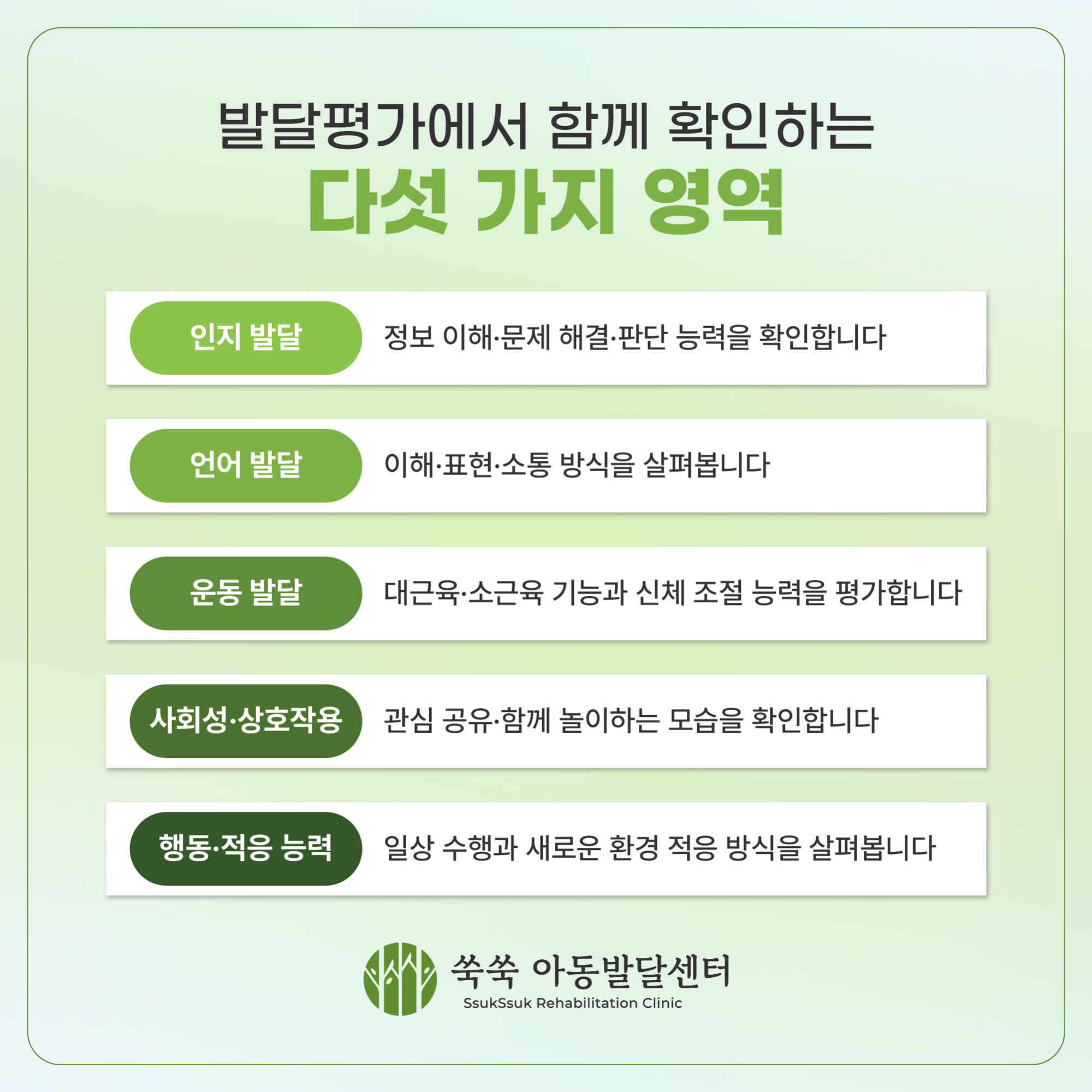
The most basic place to start is a Developmental Assessment. Rather than looking at one area in isolation, it brings everything together to see where your child is doing well and where a closer look is needed. It covers five main areas.
- Cognitive development — taking in and understanding information, solving problems in new situations, thinking and making judgments
- Language development — understanding speech, expressing thoughts, and how your child communicates with others
- Motor development — gross motor movements like walking and running, fine motor skills using the hands, and body control
- Social skills and interaction — showing interest in others, playing together, and sharing attention
- Behavior and adaptive skills — handling the everyday actions daily life requires, and adjusting to new environments
One option within a Developmental Assessment is the Bayley Scales of Infant and Toddler Development (Bayley). Designed for children from 1 to 42 months, it looks at cognitive, language, motor, social-emotional, and adaptive behavior together to help identify current developmental level and what kind of support is needed.
Which language tests are used, and what do they look at?
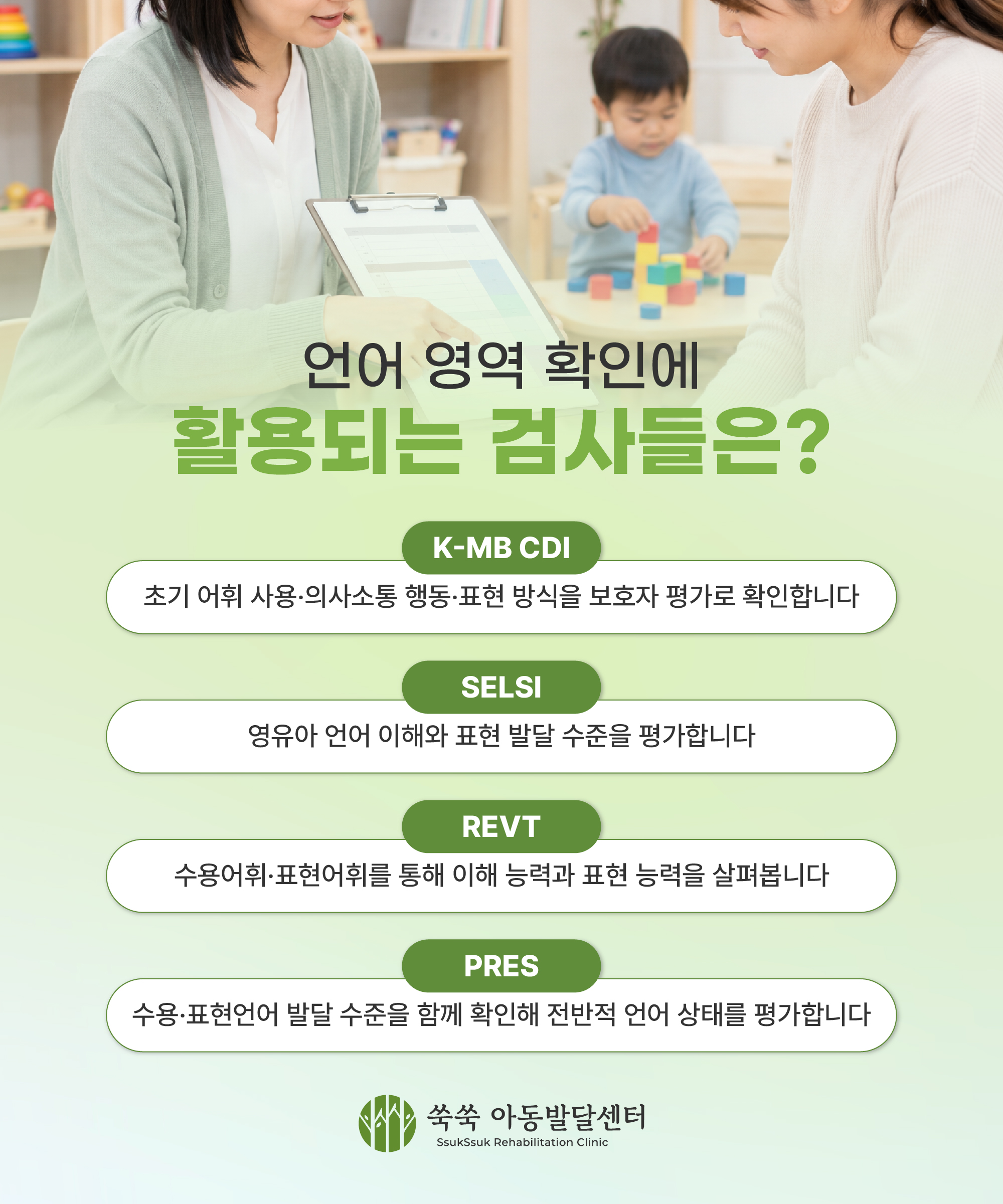
If the further-evaluation result points to a need to check language development, a language assessment can take a closer look. A language assessment isn't about counting how many words your child says—it looks at language development as a whole, including understanding, expression, vocabulary, and how your child communicates.
Every child has different sticking points in language development, so it's important to choose tests that fit your child's age and current abilities.
Beyond language: Sensory Integration Assessment
It's easy for worries to center on whether your child is late to talk or how many words they use, but development happens across many connected areas. How your child takes in and regulates sensory information, how they move their body, and how they adapt to their environment are all tied to overall development.
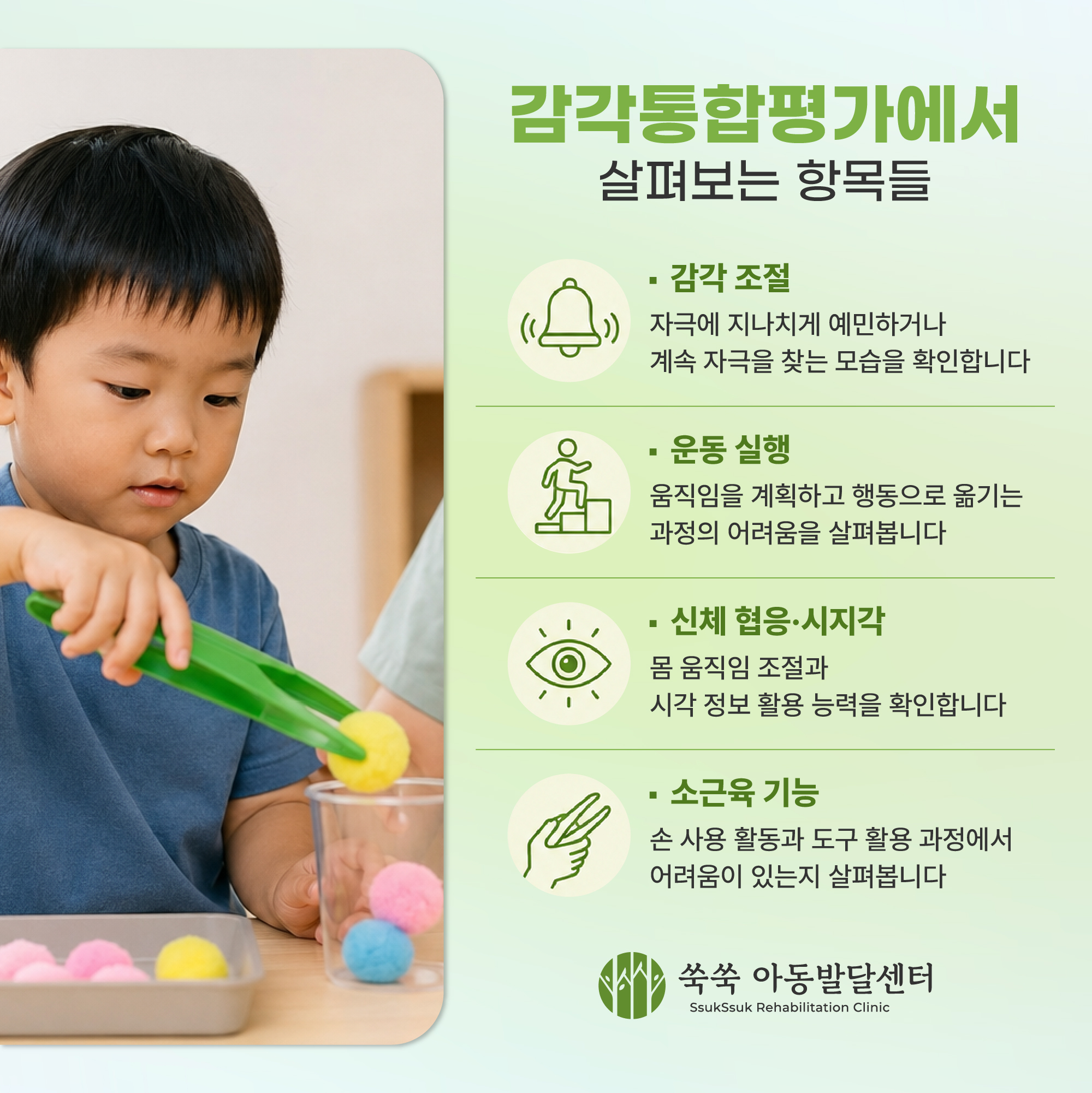
A sensory integration assessment looks at how your child takes in and regulates sensory information such as sight, sound, and touch. It mainly focuses on:
- Sensory regulation: whether your child is overly sensitive to certain stimuli, or the opposite—constantly seeking them out
- Motor planning (praxis): whether it's hard to plan a movement they have in mind and actually carry it out
- Body coordination and visual-perceptual processing: the ability to control body movements and use visual information
- Fine motor skills: difficulties with hand-based activities or handling tools
This step helps sort out whether the difficulty is just about expressive language or connected to other areas of development.
Therapy options based on assessment results
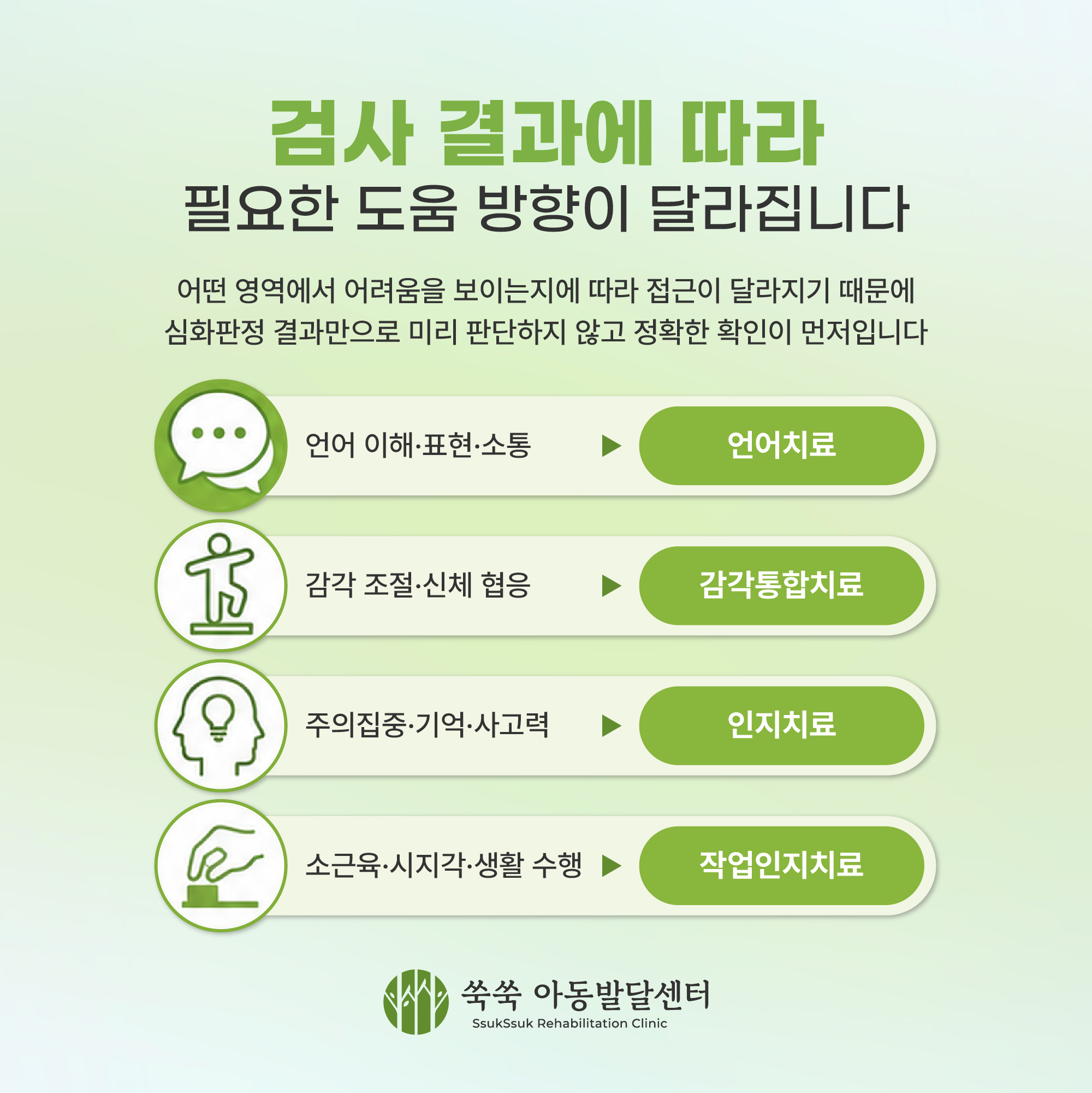
The purpose of testing after a further-evaluation result is to understand where your child is now and find the right kind of help. The same approach doesn't fit every child.
In summary
The starting point is not to jump to conclusions about your child based on the further-evaluation result alone. Looking at overall development through a Developmental Assessment, taking a closer look at specific areas with language and sensory integration assessments, and then connecting your child to the right support can be the first step toward understanding their development.
Last reviewed: 2026-10-07 This article is for general information only. Your child's developmental status and treatment plan are determined through consultation and assessment.