
Why Stiff Shoulders Still Don't Feel Better After You Loosen Them
Hello, I'm Dr. Lee Soo Jin, Director of Ssukssuk Rehabilitation Medicine Clinic. When your shoulders feel stiff and heavy, there's usually one thing you try first.
Stiff, knotted shoulders | Bangbae-dong
Hello, I'm Dr. Lee Soo Jin, Director of Ssukssuk Rehabilitation Medicine Clinic.
When your shoulders feel stiff and heavy, there's usually one thing you try first.
You might gently roll your neck, shrug your shoulders up and down, press on the tight spots with your hands, or get a massage or apply a warm compress, and feel like things have "loosened up a bit."
These methods can indeed help by temporarily relaxing tense muscles, improving blood flow, and reducing discomfort.
But many people describe a similar experience:
"It feels fine at the time, but a few days later it tightens up again."
"I keep loosening it up, so why does it keep coming back?"
To answer this question, we need to think about the word "knotted" a little differently.
What we commonly call shoulder knots doesn't simply mean hardened muscles. It can be a signal that builds up from many changes, such as repetitive postures, certain movement habits, strain on surrounding tissues, and the compensations your body makes to stay balanced.
In other words, relieving the stiffness you feel right now and looking for the cause so the same problem doesn't come back are two different approaches.
Stiff, knotted shoulders | Bangbae-dong
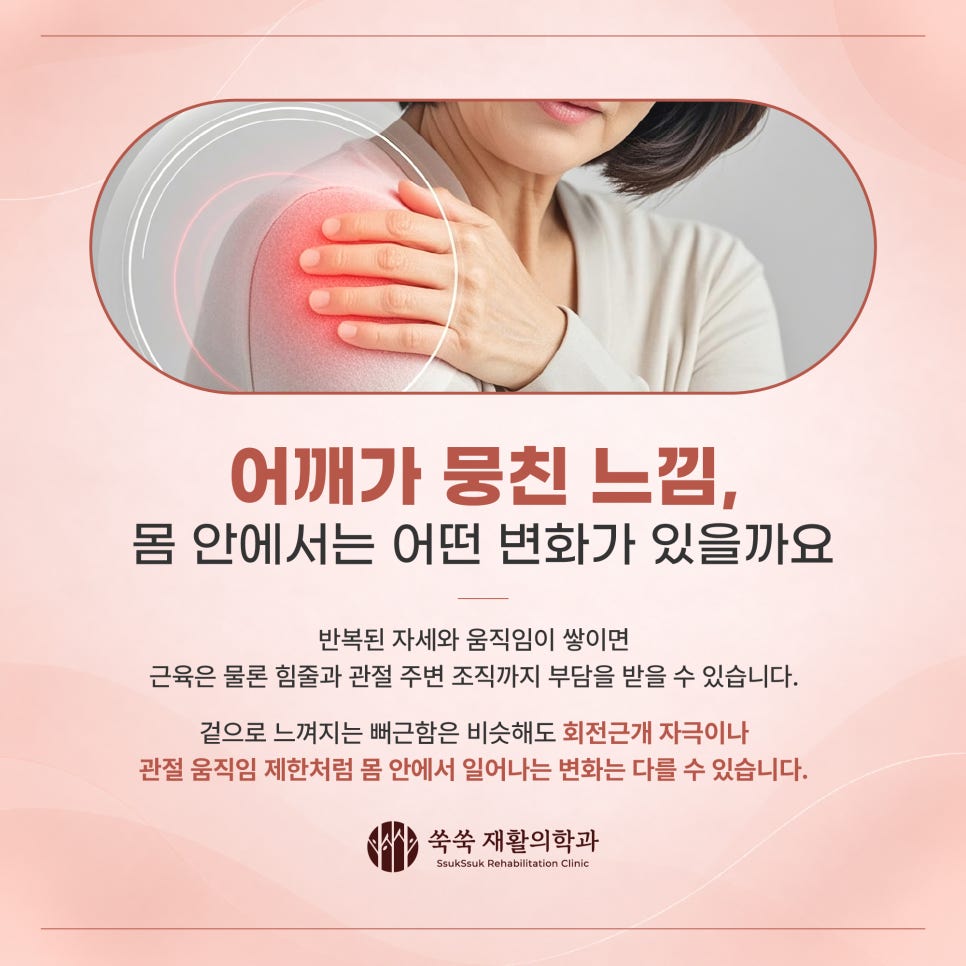
What's Happening Inside When Your Shoulders Feel Knotted?
The shoulder area is one of the most frequently used parts of the body. Everyday movements like lifting your arm, grabbing objects, washing your hair, and getting dressed all involve the muscles, tendons, and joint structures around the neck and shoulders working together. Areas that are used this constantly easily accumulate small, repeated strains.
For example, office workers who spend long hours at a computer often hold a posture where the head juts forward and the shoulders round inward. When this continues, the muscles around the neck and shoulders have to work harder than usual to support the weight of the head.
At first, this may feel like simple fatigue or heaviness. But if it persists, certain muscles can stay in a constant state of tension and movement around them may become restricted.
However, not all shoulder knots start with muscle fatigue. Similar stiffness can also occur when repeated irritation builds up around tendons such as the rotator cuff, or when the shoulder joint doesn't move smoothly and the surrounding tissues take on extra strain instead.
That's why the symptom may feel the same, described simply as "knotted," while the actual changes happening inside the body can be different.
Stiff, knotted shoulders | Bangbae-dong
You Need to Find Out What Kind of Shoulder Tightness You Have
Shoulder tightness doesn't always come from the same cause.
During an exam, we don't just look at "where it's uncomfortable." We also check the situations in which the symptoms appear.
For example:
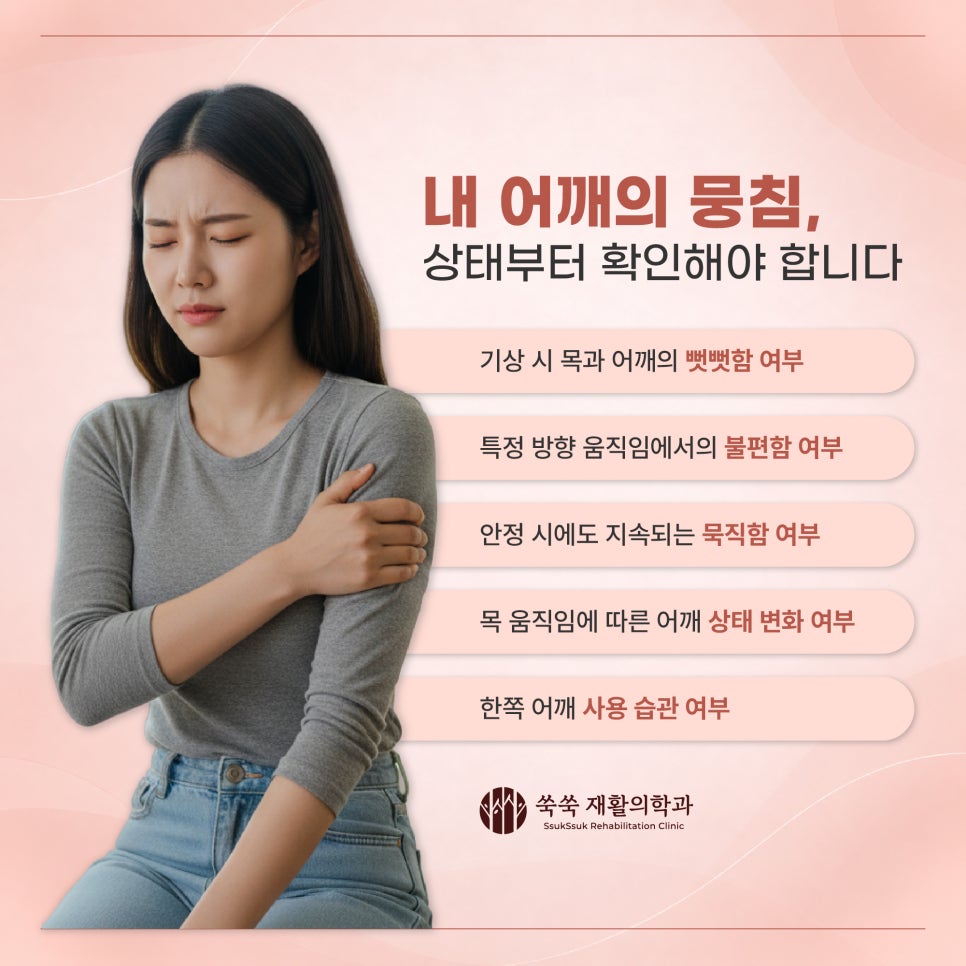
- Whether your neck and shoulders feel especially stiff when you wake up,
- Whether discomfort occurs in certain directions when you raise your arm or reach behind you,
- Whether a heavy feeling persists even when you're at rest,
- Whether your shoulder changes depending on how you move your neck,
- Whether you habitually use one shoulder more than the other,
These are important factors in assessing your current condition.
When needed, we use X-rays to check joint structure and alignment, and ultrasound to examine the tendons, including the rotator cuff, and the surrounding tissues.
Ultrasound is especially useful for checking soft tissues such as muscles and tendons that are hard to see on X-rays, helping us identify the structures causing pain.
This process isn't simply about finding "the knotted spot." It's about understanding why strain keeps building up in the same area, identifying what's getting in the way of recovery, and setting the right direction for treatment.
Stiff, knotted shoulders | Bangbae-dong
How You Recover Depends on Your Condition
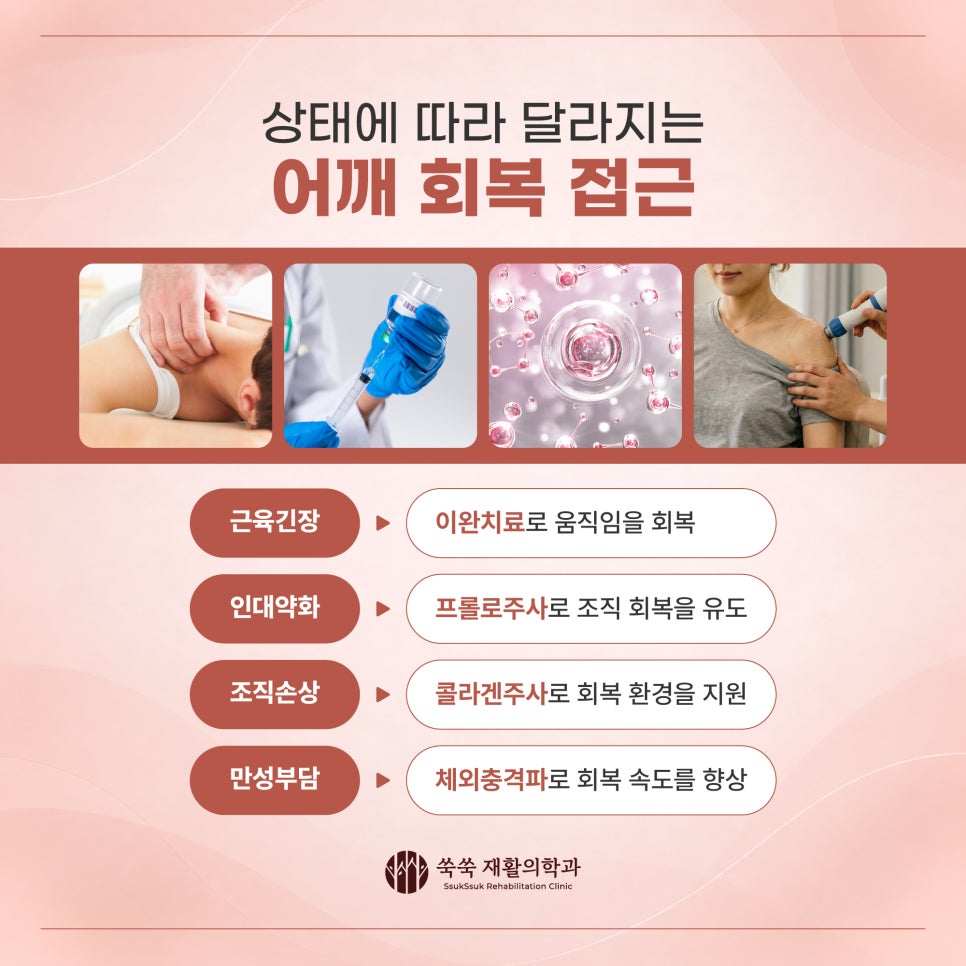
Not every case of shoulder tightness is managed the same way. If muscle tension is the main cause, relaxing the tense areas and restoring restricted movement can help.
But if repetitive use has weakened the tendons or the tissues around the ligaments, or the balance between damage and repair has broken down, simply loosening things up may not be enough.
In these cases, injection therapy may be considered depending on the condition of the tissue. Prolotherapy involves injecting a treatment solution into weakened ligaments and tendons to stimulate the body's own healing process. It's used to help tissues that have lost stability from repeated strain move into a recovery process.
Collagen injections use collagen, a major component of connective tissues such as tendons and ligaments, to help support an environment in which damaged tissue can recover.
When tissue strain is chronic or healing has slowed, extracorporeal shockwave therapy (ESWT) may also be used to deliver stimulation to the area and support the recovery process.
Ultimately, what matters is not loosening the tight spot no matter what, but first understanding what changes are happening in your shoulder and then taking the approach it needs.

Stiff, knotted shoulders | Bangbae-dong
For Recurring Shoulder Tightness, Look at How You Use Your Body Day to Day
Your shoulders work all day long, even if you don't exercise.
Long hours at a computer, looking down at your smartphone, carrying a bag on one shoulder, and repetitive tasks in the same direction are all everyday habits you may not think much about, but they can affect your shoulders.
Also, if you unconsciously avoid certain movements because of pain or discomfort, the unused areas can lose function and strain can concentrate on other areas. That's why, if the same postures and movements continue after treatment, similar discomfort may come back.
Taking care of your shoulders isn't just about loosening up the stiff spots.
It's a process of looking at how you currently use your body, whether you have habits that repeatedly cause strain, and whether your movement has changed from before.
If shoulder tightness keeps coming back, rather than looking only for quick relief, it's better to find out what changes are building up in your shoulder and find the right way to manage them.